Select Page

Global Advisors | Quantified Strategy Consulting

Warren Buffet
Quote: Warren Buffet – Investor

Quote: Warren Buffet – Investor

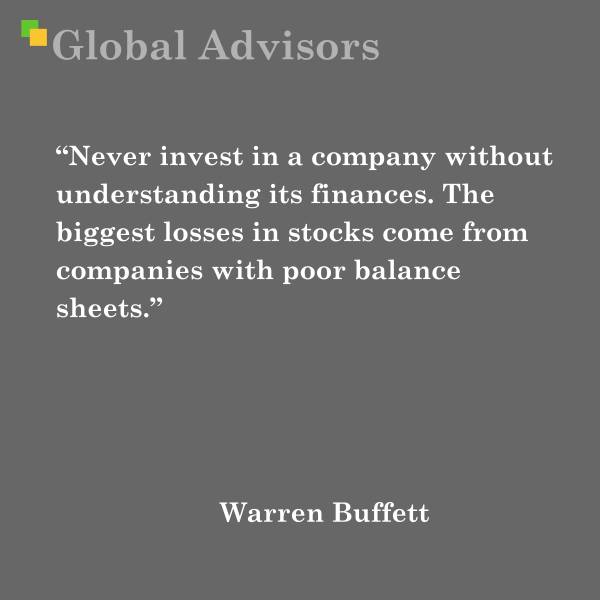
“Never invest in a company without understanding its finances. The biggest losses in stocks come from companies with poor balance sheets.” – Warren Buffet – Investor

This statement encapsulates Warren Buffett’s foundational conviction that a thorough understanding of a company’s financial health is essential before any investment is made. Buffett, revered as one of the world’s most successful and influential investors, has built his career—and the fortunes of Berkshire Hathaway shareholders—by analysing company financials with forensic precision and prioritising robust balance sheets. A poor balance sheet typically signals overleveraging, weak cash flows, and vulnerability to adverse market cycles, all of which heighten the risk of capital loss.

Buffett’s approach can be traced directly to the principles of value investing: only purchase businesses trading below their intrinsic value, and rigorously avoid companies whose finances reveal underlying weakness. This discipline shields investors from the pitfalls of speculation and market fads. Paramount to this method is what Buffett calls a margin of safety—a buffer between a company’s market price and its real worth, aimed at mitigating downside risks, especially those stemming from fragile balance sheets. His preference for quality over quantity similarly reflects a bias towards investing larger sums in a select number of financially sound companies rather than spreading capital across numerous questionable prospects.

Throughout his career, Buffett has consistently advocated for investing only in businesses that one fully understands. He famously avoids complexity and “fashionable trends,” stating that clarity and financial strength supersede cleverness or hype. His guiding mantra to “never lose money,” and the prompt reminder “never forget the first rule,” further reinforces his risk-averse methodology.

Background on Warren Buffett

Born in 1930 in Omaha, Nebraska, Warren Buffett demonstrated an early fascination with business and investing. He operated as a stockbroker, bought and sold pinball machines, and eventually took over Berkshire Hathaway, transforming it from a struggling textile manufacturer into a global conglomerate. His stewardship is defined not only by outsized returns, but by a consistent, rational framework for capital allocation; he eschews speculation and prizes businesses with predictable earnings, capable leadership, and resilient competitive advantages. Buffett’s investment tenets, traced back to Benjamin Graham and refined with Charlie Munger, remain the benchmark for disciplined, risk-conscious investing.

Leading Theorists on Financial Analysis and Value Investing

The intellectual foundation of Buffett’s philosophy rests predominantly on the work of Benjamin Graham and, subsequently, David Dodd:

  • Benjamin Graham
    Often characterised as the “father of value investing,” Graham developed a rigorous framework for asset selection based on demonstrable financial solidity. His landmark work, The Intelligent Investor (1949), formalised the notion of intrinsic value, margin of safety, and the critical analysis of financial statements. Graham’s empirical, rules-based approach sought to remove emotion from investment decision-making, placing systematic, intensive financial review at the forefront.
  • David Dodd
    Co-author of Security Analysis with Graham, Dodd expanded and codified approaches for in-depth business valuation, championing comprehensive audit of balance sheets, income statements, and cash flow reports. The Graham-Dodd method remains the global standard for security analysis.
  • Charlie Munger
    Buffett’s long-time business partner, Charlie Munger, is credited with shaping the evolution from mere statistical bargains (“cigar butt” investing) towards businesses with enduring competitive advantage. Munger advocates a broadened mental toolkit (“worldly wisdom”) integrating qualitative insights—on management, culture, and durability—with rigorous financial vetting.
  • Peter Lynch
    Known for managing the Magellan Fund at Fidelity, Lynch famously encouraged investors to “know what you own,” reinforcing the necessity of understanding a business’s financial fibre before participation. He also stressed that the gravest investing errors stem from neglecting financial fundamentals, echoing Buffett’s caution on poor balance sheets.
  • John Bogle
    As the founder of Vanguard and inventor of the index fund, Bogle’s influence stems from his advocacy of broad diversification—but he also warned sharply against investing in companies without sound financial disclosure, because broad market risks are magnified in the presence of individual corporate failure.

Conclusion of Context

Buffett’s quote is not merely a rule-of-thumb—it expresses one of the most empirically validated truths in investment history: deep analysis of company finances is indispensable to avoiding catastrophic losses. The theorists who shaped this doctrine did so by instituting rigorous standards and repeatable frameworks that continue to underpin modern investment strategy. Buffett’s risk-averse, fundamentals-rooted vision stands as a beacon of prudence in an industry rife with speculation. His enduring message—understand the finances; invest only in quality—remains the starting point for both novice and veteran investors seeking resilience and sustainable wealth.
read more
Quote: Warren Buffet – Investor

Quote: Warren Buffet – Investor

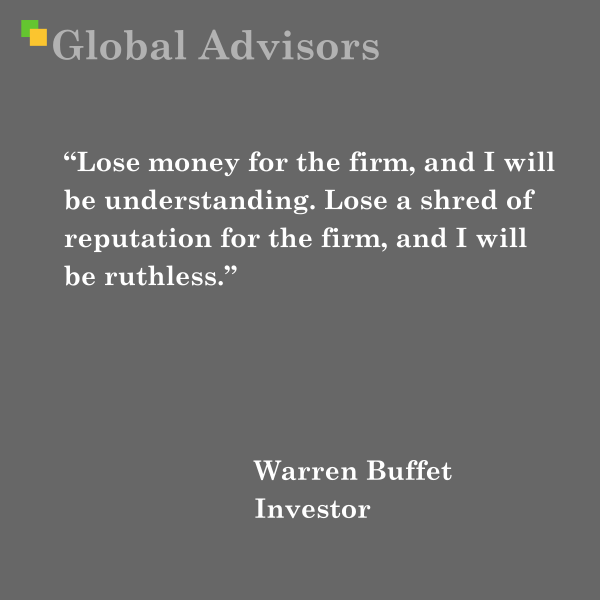
“Lose money for the firm, and I will be understanding. Lose a shred of reputation for the firm, and I will be ruthless.” – Warren Buffet – Investor

The roots of this guidance reach deep into Buffett’s extensive experience as both a legendary investor and a transformative leader, most notably during his tenure as chairman and CEO of Berkshire Hathaway and during his crisis stewardship at Salomon Brothers in the early 1990s.

Historical Context of the Quote

The quote first gained prominence in 1991 amidst the Salomon Brothers bond trading scandal, when Buffett was brought in to stabilise the embattled investment bank. Upon assuming the chairmanship, he delivered this message unequivocally to all staff, signalling that reputation would outweigh even substantial financial loss as the paramount concern. This principle was not a one-off; Buffett has repeatedly conveyed it through biennial memos to his senior management at Berkshire Hathaway, insisting that “the top priority — trumping everything else, including profits — is that all of us continue to zealously guard Berkshire’s reputation”.

Buffett’s approach responds to a fundamental risk in financial and professional services: while monetary losses can often be recouped over time, damage to reputation is typically irreparable and can have far-reaching effects on trust, relationships and long-term business sustainability. He underscores the notion that ethical behaviour and public perception must be held to higher scrutiny than any legal requirement — urging his teams to act only in ways they would be comfortable seeing scrutinised by an “unfriendly but intelligent reporter on the front page of a newspaper”.

Profile: Warren Buffett

Warren Buffett is widely regarded as one of the most successful investors in history, known both for his acumen in capital allocation and his unwavering focus on business integrity. Born in 1930, Buffett began investing as a child and by age 10 had developed a personal ethos centred on security and freedom through financial independence. Over subsequent decades, he built Berkshire Hathaway into a global holding company with interests ranging from insurance to manufacturing, consistently prioritising reputation alongside returns.

Buffett’s leadership style is defined by operational autonomy for his CEOs — but only within the bounds of absolute ethical conduct. Rather than large compliance departments, he champions a culture of integrity, believing “organisational culture,” not policy, is the primary safeguard against reputational risk.

Reputation Management: Theoretical Foundations and Thought Leaders

The foundational importance of reputation in business has been explored by leading theorists across management, economics, and corporate governance.

  • Warren Buffett (Practitioner-Theorist): Buffett’s actions embody the close relationship between reputation, trust and business value, arguing that reputation is a compound asset that underpins all long-term success.

  • Charles Fombrun: A pre-eminent academic in reputation studies, Fombrun formalised the idea of corporate reputation as a key intangible asset in his book Reputation: Realizing Value from the Corporate Image. Fombrun’s work posits that strong reputations differentiate organisations, influence stakeholder decisions, and result in enduring competitive advantage.

  • Robert Eccles: Eccles’ scholarship, especially in the realm of integrated reporting, underlines that transparency and ethical conduct must permeate a firm’s disclosures and operations, not only to satisfy regulators, but also to cultivate trust with investors, customers and the wider community.

  • John Kay: In works such as The Honest Corporation, Kay explores how robust reputational capital shields organisations not only from customer flight, but also from regulatory censure and predatory competitors.

These theorists converge on the conclusion that reputation is both a strategic and ethical asset: difficult to build, easily destroyed, and impossible to replace through mere financial resources. The most effective leaders do not simply avoid misconduct; they actively cultivate an organisational culture in which every decision passes the test of stakeholder scrutiny and enduring trust.

Supporting Case Studies and Illustrations

  • The Salomon Brothers scandal is a classic case in how reputational mismanagement can threaten not just profitability, but organizational survival. Buffett’s actions there, and at Berkshire Hathaway, have been repeatedly cited in academic and professional literature as exemplars for crisis management and corporate culture.

  • Conversely, numerous scandals in financial services illustrate that even robust compliance departments are not a substitute for culture, aligning with Buffett’s observation that “the organisations with the biggest compliance departments… have the most scandals”.

Enduring Relevance

Buffett’s doctrine — ruthless defence of reputation over financial performance — remains highly relevant. It encapsulates hard-won wisdom: trust is the currency with the highest compounding returns in business history, and its loss cannot be reversed by any sum of money.

This philosophy has shaped the approaches of some of the most influential contemporary theorists and corporate leaders, cementing reputation management as an essential pillar of modern strategy and governance.

read more
Quote: Warren Buffet – investor

Quote: Warren Buffet – investor

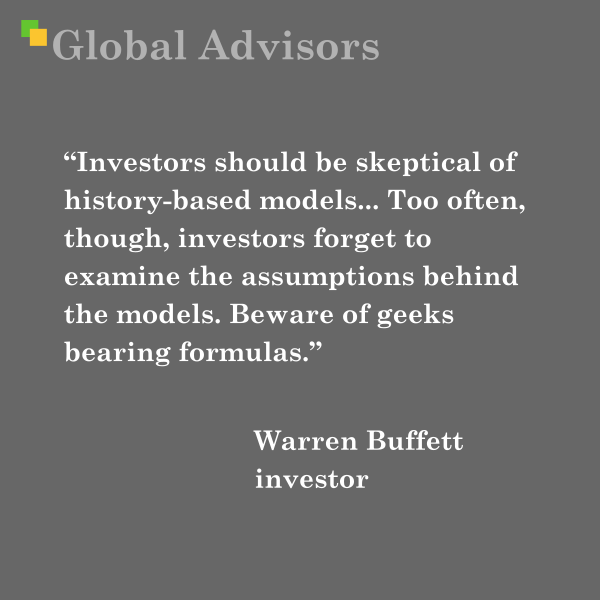
Investors should be skeptical of history-based models… Too often, though, investors forget to examine the assumptions behind the models. Beware of geeks bearing formulas.
– Warren Buffet, Investor

The quote reflects Warren Buffett’s deeply pragmatic and experience-driven approach to investing. Buffett, widely regarded as one of the most successful investors of all time, has built his reputation on a disciplined method that values understanding businesses fundamentally over relying on complex quantitative models.

Buffett’s skepticism toward “history-based models” stems from his belief that numerical formulas—no matter how sophisticated—are only as good as the assumptions underlying them. These models often use statistical terms like beta, gamma, and sigma, which sound impressive but can obscure critical factors affecting a company’s future performance. He warns investors not to be seduced by formulas crafted by what he calls a “nerdy-sounding priesthood,” emphasizing the importance of knowing the meaning and context behind every symbol or number in an equation rather than blindly trusting them.

This perspective is rooted in Buffett’s longstanding investment philosophy: that success comes from investing in businesses with durable competitive advantages, competent management, and predictable long-term prospects—not from placing faith in past data or overengineered predictive tools. He advocates for disciplined fundamental analysis and warns against overreliance on models that assume the future will closely mirror the past—a dangerous assumption in markets characterized by uncertainty and change.

Buffett’s approach also embodies patience and common sense. His advice to “buy into a company because you want to own it, not because you want the stock to go up,” and to “draw a circle around businesses you understand,” reiterates his preference for simplicity and clarity over complexity and guesswork. By highlighting the risk of blindly trusting “geeks bearing formulas,” Buffett cautions investors to balance quantitative analysis with qualitative insight and critical thinking.

In essence, this quote is a timeless reminder that investing is as much an art as it is a science. While quantitative tools can provide useful information, they should never replace thorough, skeptical evaluation of a company’s true business fundamentals. Buffett’s wisdom encourages investors to question assumptions, understand what lies beneath the numbers, and prioritize sound judgment over flashy formulas.

Warren Buffett’s career and success amplify this message. As chairman and CEO of Berkshire Hathaway, he has famously rejected fads and complex financial engineering in favor of straightforward value investing principles. His practical, grounded approach has guided generations of investors to see beyond surface metrics and embrace a thoughtful, long-term view of investing.

read more
Quote: Warren Buffett, American business magnate, investor and philanthropist

Quote: Warren Buffett, American business magnate, investor and philanthropist

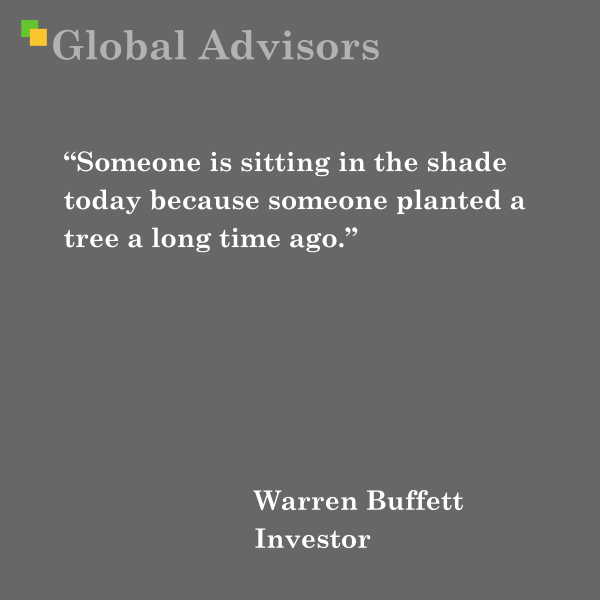
“Someone is sitting in the shade today because someone planted a tree a long time ago.” – Warren Buffett, American business magnate, investor and philanthropist

Warren Edward Buffett, widely known as the “Oracle of Omaha,” has built an extraordinary legacy as one of history’s most successful investors. Born on August 30, 1930, in Omaha, Nebraska, to Howard and Leila Buffett, he was the second of three children and the only son. His father was a stockbroker and four-term U.S. congressman who held Republican and libertarian views.

Early Life and Education

Buffett showed entrepreneurial spirit from a young age, selling chewing gum, Coca-Cola, and magazines to make a profit. By age 11, he had purchased his first stock, demonstrating his early interest in investing. At 14, he made his first real estate investment, further showcasing his financial acumen.

After graduating from the University of Nebraska-Lincoln with a business administration degree in 1951, Buffett was rejected by Harvard but went on to study at Columbia Business School under Benjamin Graham, the legendary “father of value investing”. This mentorship proved formative, as Graham’s philosophy of buying undervalued companies and holding them long-term became central to Buffett’s investment strategy.

Building Berkshire Hathaway

After earning his Master of Science in economics from Columbia, Buffett briefly worked at his father’s brokerage firm, Buffet-Falk Company. He then worked at Graham’s partnership before returning to Omaha in 1956, where he began purchasing stock in undervalued companies and building his portfolio.

In 1962, Buffett started acquiring shares in a struggling textile company called Berkshire Hathaway. By 1965, he had gained control of the company, naming himself director after owning forty-nine percent of shares. He fired the original owner, Seabury Stanton, and in the late 1960s, bought out the other majority shareholder, Jack Ringwalt, for nearly nine million dollars. Buffett became CEO of Berkshire Hathaway in 1970, transforming it from a faltering textile mill into a financial powerhouse.

Investment Philosophy and Success

The quote “Someone is sitting in the shade today because someone planted a tree a long time ago” perfectly encapsulates Buffett’s investment philosophy. As a true value investor, he focuses on purchasing underpriced but solid companies and holding them for the long term. This approach emphasizes patience and foresight—planting seeds today that will grow into towering trees providing shade (returns) for future generations.

Through sound investments and strategic acquisitions, Buffett turned Berkshire Hathaway into a multi-billion-dollar conglomerate. His personal fortune has grown to over $150 billion according to Forbes, making him one of the wealthiest individuals in the world.

Philanthropy and Legacy Planning

Despite his immense wealth, Buffett is known for his modest lifestyle. In 2008, he earned a total compensation of just $175,000, which included a base salary of only $100,000. He has lived in the same five-bedroom stucco house in Omaha since 1958.

In 2006, Buffett announced he would gradually give away 85% of his Berkshire holdings to five foundations, with the largest contribution going to the Bill and Melinda Gates Foundation. He has pledged to donate the vast majority of his personal fortune to charitable causes upon his death.

Retirement Announcement

In a significant development, Warren Buffett recently announced his plans to retire in 2025. This announcement marks the end of an era for one of the most influential investors in history. In 2007, Buffett had mentioned in a letter to shareholders that he was looking for a younger successor, or perhaps successors, to run his investment business.

The timing of his retirement coincides with his vision of planting trees for others to enjoy the shade. Through his decades of wise investments and business acumen, Buffett has created lasting value that will continue to benefit stakeholders long after his retirement.

The quote about planting trees reflects not only his investment strategy but also his approach to succession planning and philanthropy—ensuring that the shade of his achievements continues to benefit others for generations to come.

read more

Download brochure

Introduction brochure

What we do, case studies and profiles of some of our amazing team.

Download

Our latest podcasts on Spotify

Sign up for our newsletters - free

Global Advisors | Quantified Strategy Consulting