Select Page

ARTIFICIAL INTELLIGENCE

An AI-native strategy firm

Global Advisors: a consulting leader in defining quantified strategy, decreasing uncertainty, improving decisions, achieving measureable results.

Learn MoreGlobal Advisors AI

A Different Kind of Partner in an AI World

AI-native strategy
consulting

Experienced hires

We are hiring experienced top-tier strategy consultants

Quantified Strategy

Decreased uncertainty, improved decisions

Global Advisors is a leader in defining quantified strategies, decreasing uncertainty, improving decisions and achieving measureable results.

We specialise in providing highly-analytical data-driven recommendations in the face of significant uncertainty.

We utilise advanced predictive analytics to build robust strategies and enable our clients to make calculated decisions.

We support implementation of adaptive capability and capacity.

Our latest

Thoughts

The AI Signal from The World Economic Forum 2026 at Davos

The AI Signal from The World Economic Forum 2026 at Davos

Davos 2026 ( WEF26 ) signalled a clear shift in the AI conversation: less speculation, more execution. For most corporates, the infrastructure stack matters, but it will be accessed via hyperscalers and service providers rather than built internally. The more relevant question is what happens inside the organisation once the capability is available.

A consistent theme across discussions: progress is coming from pragmatic leaders who are treating AI as an operating model change, not a technology project. That means building basic literacy across the workforce, redesigning workflows, and being willing to challenge legacy assumptions about how work gets done.

In the full write-up:

  • The shift from “AI theatre” to ROI and deployment reality
  • The five-layer AI stack (and why corporates mostly consume it via partners)
  • The emerging sixth layer: user readiness — and why it is becoming decisive
  • Energy and infrastructure constraints as real-world brakes on scale
  • Corporate pragmatism: moving beyond an “AI veneer” to process redesign and agentic workflows
  • Labour market implications: skills shifts, entry-level hollowing, and what employers must do now
  • The Global South dimension: barriers, pathways to competitiveness, and practical adoption strategies
  • Second-order risks: cyber exposure, mental health, and cognitive atrophy as governance issues

If you’re leading a business, the takeaway is straightforward: there are strong lessons from pragmatic programs outside of Silicon Valley.

read more

Strategy Tools

PODCAST: A strategic take on cost-volume-profit analysis

PODCAST: A strategic take on cost-volume-profit analysis

Our Spotify podcast highlights that despite familiarity, most managers do not apply CVP analysis and get it wrong in its most basic form.

The hosts explain cost-volume-profit (CVP) analysis, a crucial business tool often misapplied. It details the theoretical underpinnings of CVP, using graphs to illustrate relationships between price, volume, and profit. The hosts highlight common errors in CVP application, such as neglecting volume changes after price increases, leading to the “margin-price-volume death spiral.” The hosts offer practical advice and strategic questions to improve CVP analysis and decision-making, emphasizing the need for accurate costing and a nuanced understanding of market dynamics. Finally, the podcast provides case studies illustrating both successful and unsuccessful CVP implementations.

Read more from the original article.

read more

Fast Facts

Fast Fact: Some of your business segments are destroying value – which?

Fast Fact: Some of your business segments are destroying value – which?

By Stuart Graham

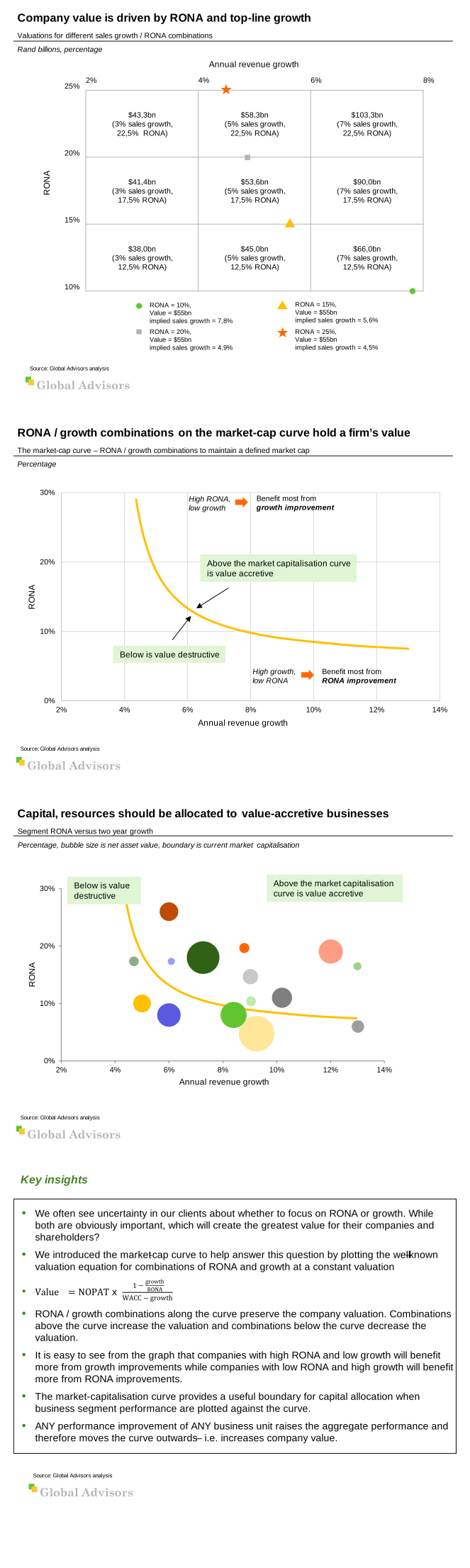
Key insights

We often see uncertainty in our clients about whether to focus on RONA or growth. While both are obviously important, which will create the greatest value for their companies and shareholders?

We introduced the market-cap curve to help answer this question by plotting the well-known valuation equation for combinations of RONA and growth at a constant valuation.

RONA / growth combinations along the curve preserve the company valuation. Combinations above the curve increase the valuation and combinations below the curve decrease the valuation.

It is easy to see from the graph that companies with high RONA and low growth will benefit more from growth improvements while companies with low RONA and high growth will benefit more from RONA improvements.

The market capitalisation curve provides a useful boundary for capital allocation when business segment performance are plotted against the curve.

ANY performance improvement of ANY business unit raises the aggregate performance and therefore moves the curve outwards – i.e. increases company value.

read more

Selected News

Quote: Jim Simons – Renaissance Technologies founder

Quote: Jim Simons – Renaissance Technologies founder

“In this business it’s easy to confuse luck with brains.” – Jim Simons – Renaissance Technologies founder

Jim Simons: A Mathematical Outsider Who Conquered Markets

James Harris Simons (1938-2024), founder of Renaissance Technologies, encapsulated the perils of financial overconfidence with his incisive observation: “In this business it’s easy to confuse luck with brains.” This quote underscores a core tenet of quantitative investing: distinguishing genuine predictive signals from random noise in market data1,2,4.

Simons’ Extraordinary Backstory

Born in Brookline, Massachusetts, to a film industry salesman father and a shoe factory manager relative, Simons displayed early mathematical brilliance. He earned a bachelor’s degree from MIT at 20 and a PhD from UC Berkeley by 23, specialising in topology and geometry. His seminal work on the Chern-Simons theory earned him the American Mathematical Society’s Oswald Veblen Prize1,2,3.

Simons taught at MIT and Harvard but felt like an outsider in academia, pursuing side interests in trading soybean futures and launching a Colombian manufacturing venture1. At the Institute for Defense Analyses (IDA), he cracked Soviet codes during the Cold War, honing skills in pattern recognition and data analysis that later fuelled his financial models. Fired for opposing the Vietnam War, he chaired Stony Brook University’s mathematics department, building it into a world-class institution1,2,4.

By his forties, disillusioned with academic constraints and driven by a desire for control after financial setbacks, Simons entered finance. In 1978, he founded Monemetrics (renamed Renaissance Technologies in 1982) in a modest strip mall near Stony Brook. Rejecting Wall Street conventions, he hired mathematicians, physicists, and code-breakers-not MBAs-to exploit market inefficiencies via algorithms2,3,4.

Renaissance Technologies: The Quant Revolution

Renaissance pioneered quantitative trading, using statistical models to predict short-term price movements in stocks, commodities, and currencies. Key hires like Leonard E. Baum (creator of the Baum-Welch algorithm for hidden Markov models) and James Ax developed early systems. The Medallion Fund, launched in 1988, became legendary, averaging 66% annual returns before fees over three decades-vastly outperforming benchmarks2,4.

Simons capped Medallion at $10 billion, expelling outsiders by 2005 to preserve edge, while public funds lagged dramatically (e.g., Medallion gained 76% in 2020 amid public fund losses)4. His firm amassed terabytes of data, analysing factors from weather to sunspots, embodying machine learning precursors like pattern-matching across historical market environments4,5. Dubbed the “Quant King,” Simons ranked among the world’s richest at $31.8 billion, yet emphasised collaboration: “My management style has always been to find outstanding people and let them run with the ball”3. He retired as CEO in 2010, with Peter Brown and Robert Mercer succeeding him4.

Context of the Quote

The quote reflects Simons’ philosophy amid Renaissance’s secrecy and success. In an industry rife with survivorship bias-where winners attribute gains to genius while ignoring luck-Simons stressed rigorous statistical validation. His models sought non-random patterns, acknowledging markets’ inherent unpredictability. This humility contrasted with boastful peers, aligning with his outsider ethos and code-breaking rigour1,4.

Leading Theorists in Quantitative Finance and Prediction

  • Leonard E. Baum: Simons’ IDA colleague and Renaissance pioneer. Baum’s hidden Markov models, vital for speech recognition and early machine learning, adapted to forecast currency trades by modelling sequential market states2,4.
  • James Ax: Stony Brook mathematician who oversaw Baum’s work at Renaissance, advancing algebraic geometry applications to financial signals2,4.
  • Edward Thorp: Precursor quant who applied probability theory to blackjack and options pricing, influencing beat-the-market strategies (though not directly tied to Simons)4.
  • Harry Markowitz: Modern portfolio theory founder (1952), emphasising diversification and risk via mean-variance optimisation-foundational to quant risk models4.
  • Eugene Fama: Efficient Market Hypothesis (EMH) proponent, arguing prices reflect all information, challenging pure prediction but spurring anomaly hunts like Renaissance’s4.

Simons’ legacy endures through the Simons Foundation, funding maths and basic science, and Renaissance’s proof that data-driven science trumps intuition in finance3. His quote remains a sobering reminder in prediction’s high-stakes arena.

References

1. https://www.jermainebrown.org/posts/why-jim-simons-founded-renaissance-technologies

2. https://en.wikipedia.org/wiki/Jim_Simons

3. https://www.simonsfoundation.org/2024/05/10/remembering-the-life-and-careers-of-jim-simons/

4. https://fortune.com/2024/05/10/jim-simons-obituary-renaissance-technologies-quant-king/

5. https://www.youtube.com/watch?v=xkbdZb0UPac

6. https://stockcircle.com/portfolio/jim-simons

7. https://mitsloan.mit.edu/ideas-made-to-matter/quant-pioneer-james-simons-math-money-and-philanthropy

"In this business it’s easy to confuse luck with brains." - Quote: Jim Simons

read more

Polls

How self-aware are you – poll results

Thank you for participating in our self awareness poll.

Our results closely match the results detailed in Tasha Eurich’s book, “Insight,” where 95% of people rate themselves self-aware but just 10 to 15% are.

See the full results here.

While visitors to the Global Advisors’ website might be more self-aware than the general population, 70% rated themselves that way!

Now read So You Think You’re Self Aware?

read more

Services

Global Advisors is different

We help clients to measurably improve strategic decision-making and the results they achieve through defining clearly prioritised choices, reducing uncertainty, winning hearts and minds and partnering to deliver.

Our difference is embodied in our team. Our values define us.

Corporate portfolio strategy

Define optimal business portfolios aligned with investor expectations

BUSINESS UNIT STRATEGY

Define how to win against competitors

Reach full potential

Understand your business’ core, reach full potential and grow into optimal adjacencies

Deal advisory

M&A, due diligence, deal structuring, balance sheet optimisation

Global Advisors Digital Data Analytics

14 years of quantitative and data science experience

An enabler to delivering quantified strategy and accelerated implementation

Digital enablement, acceleration and data science

Leading-edge data science and digital skills

Experts in large data processing, analytics and data visualisation

Developers of digital proof-of-concepts

An accelerator for Global Advisors and our clients

Join Global Advisors

We hire and grow amazing people

Consultants join our firm based on a fit with our values, culture and vision. They believe in and are excited by our differentiated approach. They realise that working on our clients’ most important projects is a privilege. While the problems we solve are strategic to clients, consultants recognise that solutions primarily require hard work – rigorous and thorough analysis, partnering with client team members to overcome political and emotional obstacles, and a large investment in knowledge development and self-growth.

Get In Touch

16th Floor, The Forum, 2 Maude Street, Sandton, Johannesburg, South Africa
+27114616371

Global Advisors | Quantified Strategy Consulting