Select Page

Global Advisors | Quantified Strategy Consulting

Leadership
Quote: Ray Dalio, Founder of Bridgewater Associates

Quote: Ray Dalio, Founder of Bridgewater Associates

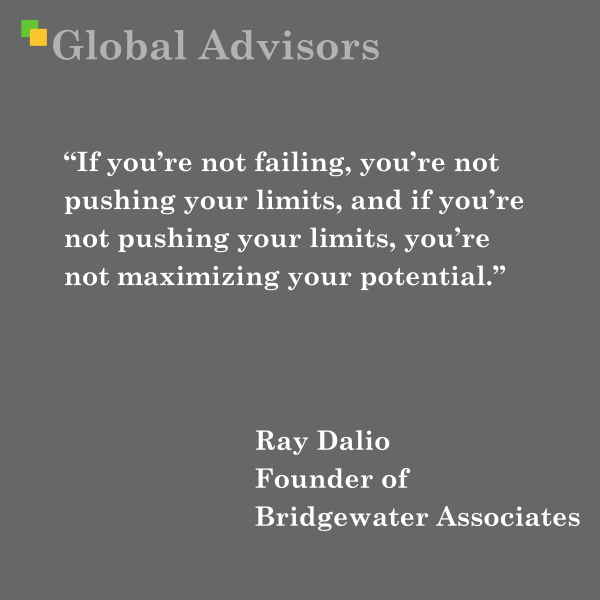
“If you’re not failing, you’re not pushing your limits, and if you’re not pushing your limits, you’re not maximizing your potential.” – Ray Dalio, Founder of Bridgewater Associates

Raymond Dalio (born 1954) is an American businessman, investor, and philanthropist. He is the founder of Bridgewater Associates, one of the world’s largest hedge fund firms, with over $100 billion in assets under management.

Early Life and Career

Dalio grew up in New Jersey and faced significant challenges early in life, including a difficult family situation and academic struggles. Despite these obstacles, he developed a strong interest in economics and finance. After working as an economist for the government, he co-founded Bridgewater Associates in 1981 with $20 million in seed capital from his own savings.

Philosophy on Success

Dalio’s philosophy emphasizes the importance of continuous learning, adaptability, and resilience. He believes that success comes from a deep understanding of oneself and one’s environment, coupled with the willingness to take risks and learn from failures. His quote highlights the idea that growth and potential are maximized when one is willing to push beyond their current limits and embrace failure as a necessary part of the learning process.

Key Teachings

  • Embracing Failure: Dalio often emphasizes that success comes from learning how to fail, not from avoiding it. He encourages individuals to take calculated risks and view failures as opportunities for growth.
  • Continuous Learning: He advocates for lifelong learning and self-improvement, believing that personal development is a continuous process.
  • Transparency and Honesty: Dalio values transparency in business and life, promoting the idea that honesty and open communication are essential for effective collaboration and decision-making.

Impact and Legacy

Dalio’s approach to investing and leadership has had a significant impact on the financial industry. He is known for his innovative investment strategies and his focus on risk management. His book, “Principles: Life and Work,” which outlines his principles for success, has become a bestseller and is widely read by professionals in various fields.

Motivational Style

Dalio’s style is characterized by his emphasis on transparency, honesty, and continuous learning. He often uses personal anecdotes and practical examples to illustrate his points, making complex ideas accessible and engaging. His ability to connect with audiences on a personal level has made him a highly influential figure in the world of business and personal development.

Influence on Modern Thought

Dalio’s teachings have influenced many modern thinkers and leaders, particularly in the fields of finance and leadership. His focus on transparency, adaptability, and continuous learning remains relevant in today’s rapidly changing business environment. Many of his ideas have been referenced and built upon by contemporary authors, speakers, and business leaders.

Personal Life

Dalio is married to Jane Bruning, and they have three children. He is known for his philanthropic efforts, particularly in the areas of education and economic development. He has founded the Ray and Jane Dalio Foundation, which supports initiatives aimed at improving social mobility and economic opportunity.

read more
Quote: Eliot Cohen, Former US Under Secretary of Defense

Quote: Eliot Cohen, Former US Under Secretary of Defense

“It is really important to use clear language about this, and call evil evil.” – Eliot Cohen, Former US Under Secretary of Defense

From “EMERGENCY EPISODE: Oval Office Ambush | Shield of the Republic – Eric Edelman and Eliot Cohen – 2nd March 2025

Eliot Cohen, an American political scientist, emphasizes the importance of clear language when discussing issues of morality and ethics. In the context of the Oval Office meeting between President Trump, Vice President Vance, and President Zelensky, Cohen’s quote highlights a critical aspect of leadership and statecraft.

Background on Eliot Cohen

Eliot Cohen is a renowned scholar and former Pentagon official who has written extensively on international relations, strategic policy, and national security. He served as the Under Secretary of Defense for Policy under President George W. Bush from 2001 to 2005.

The Importance of Clear Language

Cohen’s statement underscores the idea that when discussing matters of morality and ethics, it is crucial to use clear language to convey one’s stance. He criticizes those who downplay or excuse the behavior of President Trump and Vice President Vance by suggesting that they were simply engaging in a strategic negotiation. Cohen argues that such excuses are not only wrong but also align with Russian interests, as they undermine the credibility of Ukraine’s efforts to defend itself against aggression.

Moral Clarity and Statecraft

Cohen’s emphasis on clear language is particularly relevant during times of crisis and political tension. By calling out evil explicitly, he advocates for a more straightforward and honest approach to statecraft. This clarity helps in maintaining moral integrity and ensures that actions are not misinterpreted or justified by those with malicious intentions.

Impact and Influence

Eliot Cohen’s views on clear language have resonated with many scholars and policymakers who believe in the importance of ethical leadership. His emphasis on moral clarity has contributed to discussions on how leaders should communicate their decisions, especially during challenging international situations.

read more
Quote: Jim Rohn, American entrepreneur, author, and motivational speaker

Quote: Jim Rohn, American entrepreneur, author, and motivational speaker

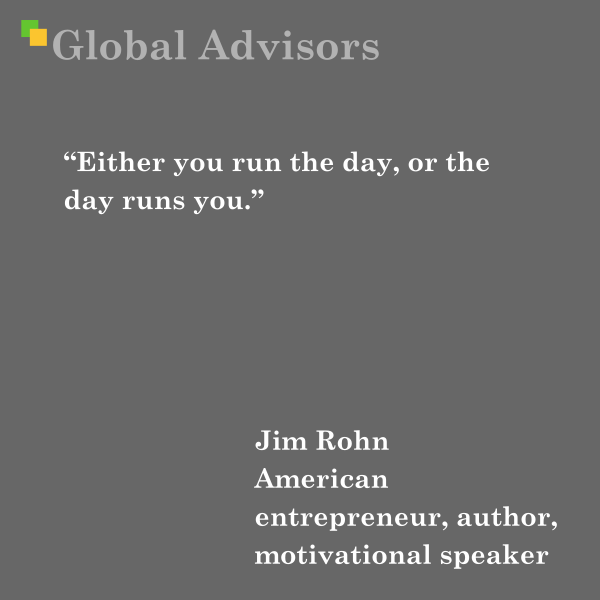
“Either you run the day, or the day runs you.” – Jim Rohn

Biography

James Murray Rohn (1932–1998) was an American entrepreneur, author, and motivational speaker who became one of the most influential figures in personal development during his lifetime. He is known for his insightful and often humorous teachings on success, wealth, and personal growth.

Early Life and Career

Rohn grew up in a small town in Indiana and faced significant challenges early in life, including poverty and an abusive father. Despite these obstacles, he worked hard to build a successful career as a sales trainer and motivational speaker. He founded Rohn Management Company, which provided training and consulting services for businesses.

Philosophy on Success

Rohn’s philosophy emphasized the importance of personal responsibility and continuous learning. He believed that success is not achieved by luck or chance but by deliberate action and consistent effort. His teachings focused on helping individuals take control of their lives and make positive changes.

Key Teachings

  • Personal Responsibility: Rohn often repeated, “The key to success is taking full responsibility for your life.” This aligns with his quote about running the day. He believed that people who are proactive and take charge of their decisions and actions are more likely to achieve their goals.
  • Continuous Learning: He was a strong advocate for lifelong learning and personal development. His books, seminars, and audio programs covered a wide range of topics, including motivation, leadership, and financial success.
  • Ethical Conduct: Rohn also emphasized the importance of ethical behavior in business and life. He believed that integrity and honesty are essential for long-term success and happiness.

Impact and Legacy

Rohn’s teachings have had a profound impact on millions of people around the world. His books, such as “The Art of Exceptional Living” and “The Four Percent Principle,” continue to be popular and influential in personal development circles. He is often compared to other motivational figures like Napoleon Hill and Zig Ziglar for his contributions to the field of self-help and motivation.

Motivational Style

Rohn’s style was known for its practicality, humor, and deep understanding of human nature. He used stories and anecdotes to illustrate his points, making complex ideas accessible and engaging. His ability to connect with audiences on a personal level has made him one of the most revered figures in motivational speaking.

Influence on Modern Thought

Rohn’s teachings continue to inspire and influence modern thinkers and leaders. His emphasis on personal responsibility and continuous learning remains relevant in today’s fast-paced and competitive world. Many of his ideas have been referenced and built upon by contemporary authors, speakers, and business leaders.

Personal Life

Rohn was married to Kathleen Rohn, and they had three children. He passed away in 1998 at the age of 65, leaving behind a rich legacy of wisdom and inspiration that continues to resonate with people worldwide.

read more
Quote: Anthony de Mello, Jesuit priest, spiritual guide and psychotherapist

Quote: Anthony de Mello, Jesuit priest, spiritual guide and psychotherapist

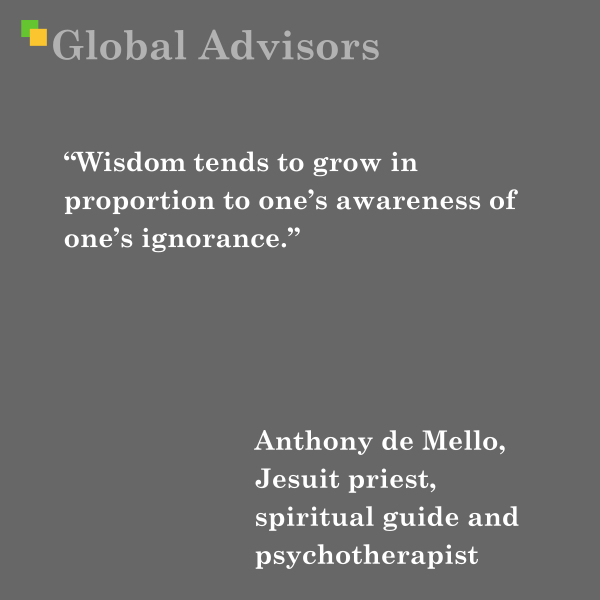
“Wisdom tends to grow in proportion to one’s awareness of one’s ignorance.” – Anthony de Mello, Jesuit priest, spiritual guide, and psychotherapist

Anthony de Mello was a renowned spiritual teacher and author known for his work on the intersection of spirituality and psychology. His quote highlights an essential aspect of personal growth and self-improvement—the idea that true wisdom comes from recognizing our limitations and understanding what we don’t know.

De Mello’s message suggests that when individuals acknowledge their ignorance or areas where they lack knowledge, they create a space for learning and growth. This awareness fosters humility, encourages open-mindedness, and motivates people to seek out new information and experiences. It is through this process of self-reflection and acceptance of one’s limitations that true wisdom can flourish.

This quote has resonated with many individuals seeking personal development and those in leadership roles who strive to create a culture of continuous learning within their organizations.

Biography

Anthony de Mello, SJ (1931–1987), was an Indian Jesuit priest, spiritual guide, and psychotherapist. He is widely regarded as one of the foremost mystical theologians of the late 20th century. De Mello’s work focused on helping individuals achieve a deeper understanding of their spiritual nature through his unique approach to life and spirituality.

Early Life and Education

De Mello was born in Mumbai (then Bombay), India, into a Catholic family. He originally learned with great discipline the spiritual practices of Ignatius of Loyola, the founder of the Jesuit Order. This foundation laid the groundwork for his future as a master teacher in spiritual retreats that incorporated yoga, vipassana meditation, and other oriental and multicultural spiritual practices.

Spiritual Teaching and Influence

De Mello’s approach to life was simple and direct, often using stories and anecdotes to illustrate profound spiritual truths. He believed that happiness and freedom come from within and that our thoughts are our worst enemies. His books, such as “A Rediscovery of Life,” continue to be influential in contemporary spirituality, emphasizing the importance of self-awareness and acceptance of one’s spiritual nature.

Books and Lectures

De Mello wrote several books, including “A Rediscovery of Life” (his last work), “Doa Sang Katak 1: Meditasi Dengan Cerita,” and “One Minute Wisdom.” His lectures and retreats have had a significant impact on individuals worldwide, helping them to perceive conflicts and paradoxes differently.

Humanitarian Outreach

De Mello was also deeply committed to humanitarian causes. He took at heart the recommendations of the Vatican II Council, showing the way for a possible renovation of Catholic ministry and offering a deeper understanding to people of all faiths or no particular faith. His work continues to inspire attempts to bring about what Ken Wilber calls the “Conveyor Belt” of churches.

Legacy and Recognition

De Mello’s sudden death in 1987 at the age of 56 left a profound impact on his followers and colleagues. He is remembered as a man of much charisma, who became well-known throughout the world through his books, lectures, and retreats. The DeMello Spirituality Center, founded in 1984, continues to extend his approach and message globally.

Influence on Modern Thought

De Mello’s influence extends beyond his own lifetime. His ideas have been integrated into various spiritual traditions and are often compared to those of other important pioneers like Trappist monk Thomas Merton and Fr. Thomas Keating O.C.S.O. His works stand in line with an emerging Integral Catholicism, contributed by Catholic creatives such as Fr. Thomas Berry C.P.

Critical Reception

De Mello’s work has also prompted a censoring reaction from the Vatican’s Congregation for the Doctrine of the Faith, which led to a reaction in liberal sections of the U.S. Roman Catholic Church and the Mid Asian synod. Despite this, he remains an influential figure in contemporary spiritual thought.

Personal Life

De Mello was known for his sincere and friendly attitude towards people from every religious persuasion, making him comfortable and at home near him. He expressed himself as a genuine brother to all and came to understand that the genuine Catholic Church encompasses all people: Christians and non-Christians.

read more
Quote: Jamie Dimon, CEO JP Morgan

Quote: Jamie Dimon, CEO JP Morgan

“When someone says you have cancer, your life changes. I tell a lot of people, everyone knows they’re going to die, but when they say it, all of a sudden it’s like in your face, and you have to contemplate dying all the time, even now as a survivor, until they say you’re in remission.” – Jamie Dimon, CEO JP Morgan

Leadership is often associated with strength, decisiveness, and unwavering focus. However, true leadership also requires vulnerability, self-awareness, and the ability to confront life’s most challenging moments with grace and resilience. This is powerfully illustrated in a quote from Jamie Dimon, Chairman and CEO of JPMorgan Chase, as he reflected on his experience with cancer: “When someone says you have cancer, your life changes. I tell a lot of people, everyone knows they’re going to die, but when they say it, all of a sudden it’s like in your face, and you have to contemplate dying all the time, even now as a survivor, until they say you’re in remission.”

Dimon, a figure known for his relentless drive and unwavering confidence, offers a deeply personal perspective on facing mortality. In the original interview, Dimon was discussing how his health challenges had changed him over time, noting, “I don’t think you realize immediately what it does.” He emphasized that a cancer diagnosis forces you to confront your own mortality in a way that few other experiences can. He also shared the emotional burden of having to tell his parents, “I didn’t want to tell my parents I may die before them.”

This quote and the surrounding context highlight several key principles:

  • The Power of Perspective: It underscores how a life-threatening illness can shift your perspective and force you to re-evaluate your priorities, leading to a more deliberate approach to life. As Dimon stated, “It does make you live a little more deliberately about how you run your life and what you do and how you spend your time.”
  • Confronting Mortality: It acknowledges the emotional and psychological challenges of facing your own mortality and the ongoing impact of that experience, even after treatment. The constant contemplation of death becomes a new reality.
  • Resilience and Gratitude: It speaks to the resilience required to navigate a serious illness and the profound sense of gratitude that can emerge from surviving such an ordeal. This resilience was further tested when Dimon later suffered a heart attack. However, he found a sense of peace in knowing that he had addressed any regrets he might have had in the time since his cancer diagnosis. As he reflected while being wheeled into surgery for his heart condition, “I knew I knew was maybe not even 50/50 I would survive, that I didn’t have any regrets because the ones I might have had I actually fixed the first time around.”
  • Impact on Leadership Style: While Dimon maintained his love for his work and country, his health challenges did change “how you deal with certain people and certain issues,” suggesting a shift in his approach to leadership.

Dimon’s message is a powerful reminder that life is precious and that leadership is not just about achieving professional success, but also about living a meaningful and fulfilling life. It’s a call to embrace vulnerability, to confront challenges with courage, and to appreciate the moments we have. It’s a reminder that true strength lies not in avoiding difficult emotions, but in facing them head-on and emerging stronger on the other side. It also highlights the importance of family and friends during difficult times. The peace he found in addressing his regrets allowed him to face a new health crisis with a sense of acceptance and resolve.

read more
Quote: Jamie Dimon, CEO JP Morgan

Quote: Jamie Dimon, CEO JP Morgan

“Make sure you have heart, and curiosity, and give a damn, and understand that you don’t know it all, and you’re not even the expert anymore.” – Jamie Dimon, CEO JP Morgan


Success in business can be intoxicating. The accolades, the power, and the financial rewards can easily lead to arrogance and detachment from the realities of the organization. However, true leadership requires humility, a willingness to learn, and a genuine connection with the people you lead. This is the essence of a powerful piece of advice from Jamie Dimon, Chairman and CEO of JPMorgan Chase: “Make sure you have heart, and curiosity, and give a damn, and understand that you don’t know it all, and you’re not even the expert anymore.”

Dimon’s words resonate deeply in a world where ego and self-promotion often overshadow genuine leadership. He’s not just offering a platitude; he’s sharing a hard-earned lesson about the importance of staying grounded, even at the highest levels of an organization. This sentiment echoes a line from the late John Weinberg, head of Goldman Sachs, whom Dimon admires: “You either grow or you swell.”

In the original interview, Dimon was discussing how to avoid letting success go to your head. He emphasized that as leaders rise through the ranks, they often become less knowledgeable about the day-to-day operations of their organizations. This can breed insecurity, leading some leaders to become controlling, isolated, and unwilling to admit what they don’t know.

This quote and the surrounding context highlight several key principles:

  • Humility as a Shield: It recognizes that humility is not a weakness, but a strength that protects leaders from arrogance and detachment.
  • The Danger of Insecurity: It acknowledges that insecurity can be a powerful force that drives leaders to make poor decisions and create toxic work environments.
  • The Importance of Continuous Learning: It underscores the need for leaders to remain curious, to seek out new knowledge, and to recognize that they are no longer the expert in every area of their organization.
  • Heart and Passion as Anchors: It emphasizes that heart (empathy, compassion) and a genuine passion for the work are essential for staying connected to the people you lead and the mission you serve.

Dimon’s message is clear: To avoid the “big head” and remain effective leaders, we must cultivate humility, embrace continuous learning, and stay connected to our people. It’s a reminder that true leadership is not about having all the answers, but about creating an environment where everyone feels empowered to contribute their unique talents and perspectives. It’s about growing, not swelling.

read more
Quote: Jamie Dimon, CEO JP Morgan

Quote: Jamie Dimon, CEO JP Morgan

“The business will always run, your results will vary, but the thing that will disappoint you the most are the people you put your trust in [who let you down].” – Jamie Dimon, CEO JP Morgan

In the world of business, success is often measured by financial performance, market share, and strategic execution. However, true leadership extends beyond these metrics. It’s about the relationships you build, the trust you inspire, and the people you empower to achieve great things. This is poignantly captured in a quote from Jamie Dimon, Chairman and CEO of JPMorgan Chase: “The business will always run, your results will vary, but the thing that will disappoint you the most are the people you put your trust in [who let you down].”

Dimon, a seasoned leader who has navigated countless challenges and triumphs, speaks to the profound impact that people can have on an organization. In the original interview, Dimon was reflecting on his biggest disappointments throughout his career. While acknowledging the inevitable ups and downs of business, he emphasized that the most painful setbacks were those caused misjudging people.

This quote highlights several key principles:

  • Trust as a Foundation: It underscores the importance of trust as the bedrock of any successful team or organization. Without trust, communication breaks down, collaboration falters, and performance suffers.
  • The Vulnerability of Leadership: It acknowledges that leaders are inherently vulnerable, as they must rely on others to execute their vision and uphold their values.
  • The Sting of Disappointment: It speaks to the deep disappointment that leaders feel when their trust is betrayed, whether through incompetence, dishonesty, a lack of commitment and most especially their own bad judgement.

Dimon’s message is a sobering reminder that leadership is not just about strategy and execution; it’s about people. It’s about carefully selecting individuals who share your values, empowering them to succeed, and holding them accountable for their actions. It’s also about recognizing that even the most talented individuals can sometimes let you down, and that the ability to learn from these experiences is essential for growth. Ultimately, this quote serves as a powerful testament to the enduring importance of trust in leadership and the high cost of its betrayal.

read more
Quote: Jamie Dimon, CEO JP Morgan

Quote: Jamie Dimon, CEO JP Morgan

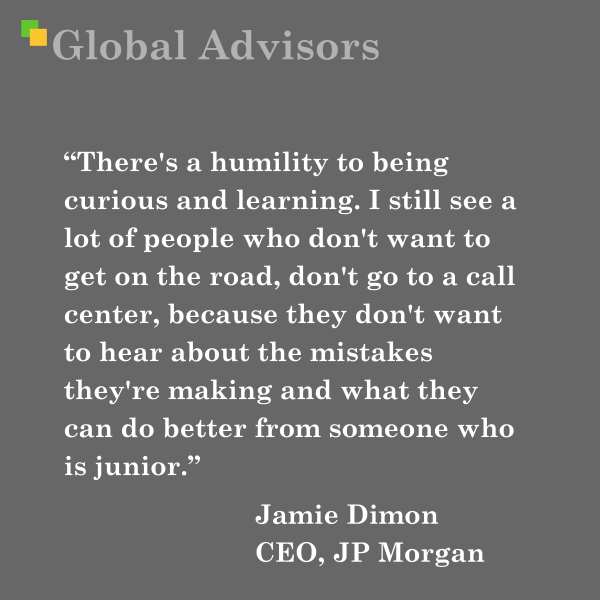
“There’s a humility to being curious and learning. I still see a lot of people who don’t want to get on the road, don’t go to a call center, because they don’t want to hear about the mistakes they’re making and what they can do better from someone who is junior.” – Jamie Dimon, CEO JP Morgan

It’s easy for leaders to become detached from the day-to-day realities of their organizations. However, true leadership requires a willingness to get your hands dirty, to listen to those on the front lines, and to embrace a culture of continuous learning. This is the essence of a powerful quote from Jamie Dimon, Chairman and CEO of JPMorgan Chase: “There’s a humility to being curious and learning. I still see a lot of people who don’t want to get in the trenches, don’t go to a call center, because they don’t want to hear about the mistakes they’re making and what they can do better from someone who is junior.”

Dimon, known for his hands-on leadership style, isn’t just talking about abstract concepts. He’s drawing from his own experiences of visiting branches, sitting down with tellers, and actively seeking feedback from employees at all levels. In the original interview, Dimon was discussing the importance of curiosity and how leaders can learn from those closest to the customer. He emphasized that a leader’s willingness to listen, even to junior employees, is crucial for identifying areas for improvement and fostering a culture of open communication.

This quote highlights several key principles:

  • Humility as a Strength: It challenges the traditional notion of leadership as a top-down, authoritative role. Instead, it emphasizes the importance of humility and a willingness to learn from others, regardless of their position.
  • The Value of Frontline Insights: It recognizes that those on the front lines often have the most valuable insights into customer needs, operational inefficiencies, and potential problems.
  • Creating a Culture of Open Communication: It underscores the importance of creating an environment where employees feel comfortable sharing their feedback, even if it’s critical of leadership.

Dimon’s message is clear: Great leaders don’t hide in their offices. They get in the trenches, listen to their people, and embrace a culture of continuous learning. By doing so, they can gain a deeper understanding of their organizations, identify areas for improvement, and build stronger, more resilient teams. It’s a reminder that true leadership is not about having all the answers, but about asking the right questions and being open to learning from those around you.

read more
Quote: Jamie Dimon, CEO JP Morgan

Quote: Jamie Dimon, CEO JP Morgan

“I think what really makes a great leader is heart, care and curiosity.” – Jamie Dimon, CEO JP Morgan

Dimon, a figure synonymous with success in the high-stakes world of finance, offers a perspective that goes beyond balance sheets and market trends. He emphasizes the importance of qualities that are often considered “soft skills,” but are, in reality, the bedrock of strong leadership.

  • Heart: This speaks to authenticity, passion, and a genuine commitment to the people and the mission. It’s about leading with integrity and demonstrating a deep-seated belief in what you’re doing.
  • Care: This is about empathy, compassion, and a genuine concern for the well-being of your team. It’s about creating a supportive environment where individuals feel valued, respected, and empowered to reach their full potential.
  • Curiosity: This is about a thirst for knowledge, a willingness to learn, and an openness to new ideas. It’s about challenging assumptions, seeking diverse perspectives, and constantly striving to improve.

These three qualities, when combined, create a powerful leadership style that resonates with people on a fundamental level. They foster trust, inspire loyalty, and drive collective success. In a world that often prioritizes metrics and outcomes, Dimon’s quote serves as a valuable reminder that the most effective leaders are those who lead with their hearts, care for their people and never stop asking questions. It’s a call to cultivate these qualities within ourselves and to seek them out in those we choose to follow.

read more
Quote: Erwin McManus

Quote: Erwin McManus

“Humility is about self-awareness.” – Erwin McManus, author, speaker, and pastor

The quote “Humility is about self-awareness” is attributed to Erwin McManus, a well-known author, speaker, and pastor. McManus is the lead pastor of Mosaic Church in Los Angeles, a church recognized for its creativity, innovation, and diverse community. He is also the author of several influential books on leadership, faith, and personal development, including The Artisan Soul, The Last Arrow, and The Way of the Warrior.

Context and Meaning Behind the Quote:
This particular quote reflects a recurring theme in McManus’s work: the connection between humility, self-awareness, and personal growth. He often emphasizes that true humility is not about self-deprecation or thinking less of yourself, but about having a clear, honest understanding of who you are—your strengths, weaknesses, and the impact you have on others.

McManus argues that humility is rooted in self-awareness because it requires recognizing both your value and your limitations. People who lack self-awareness may overestimate their abilities (leading to arrogance) or underestimate their worth (leading to insecurity). True humility emerges when you see yourself accurately and are comfortable with both your strengths and your imperfections.

Broader Themes in McManus’s Teachings:

  • Authenticity: He frequently encourages individuals to embrace their true selves rather than striving to meet external expectations.
  • Courage: Humility requires the courage to confront your weaknesses and insecurities.
  • Leadership: McManus teaches that the best leaders lead from a place of humility, which fosters trust, collaboration, and growth.

Practical Application:
When McManus says, “Humility is about self-awareness,” he is encouraging people to:

  • Reflect honestly on their actions, motives, and impact on others.
  • Embrace personal growth by being open to feedback and acknowledging areas for improvement.
  • Avoid comparison—understanding that self-worth is not determined by being better or worse than others.

This perspective aligns with the broader leadership and personal development principle that self-awareness is foundational to growth, emotional intelligence, and effective leadership.

Related Quote from McManus:
“Humility is not about pretending to be less; it is about being honest about our strengths and weaknesses.”
(The Way of the Warrior, 2019)

read more
Quote: Biz Stone

Quote: Biz Stone

“Timing, perseverance, and ten years of trying will eventually make you look like an overnight success.” – Biz Stone, Co-Founder Twitter

Success rarely happens overnight. Instead, it is often the result of years of hard work, perseverance, and strategic decision-making. The quote suggests that even seemingly rapid successes can be the culmination of a long period of effort and dedication.

Key Takeaways from the Quote

Timing: The quote underscores the significance of timing in achieving success. It implies that being at the right place at the right time can make all the difference.
Perseverance: Biz Stone emphasizes the importance of perseverance in overcoming obstacles and staying committed to one’s goals.
Ten Years of Trying: The quote suggests that even a decade of effort may be necessary to achieve success, highlighting the long-term nature of many successful endeavors.

Implications of the Quote

Long-Term Focus: It encourages individuals to adopt a long-term perspective and focus on making steady progress towards their objectives.
Resilience: The quote emphasizes the importance of resilience in overcoming setbacks and staying committed to one’s goals.
Timing is Everything: It highlights the significance of timing in achieving success, suggesting that being at the right place at the right time can make all the difference.

read more
Quote: Max Levchin

Quote: Max Levchin

“Hang on tight to those who make you a better you!”
— Max Levchin, Affirm founder and CEO, Paypal founder

Max Levchin delivered a heartfelt commencement address at the University of Illinois at Urbana-Champaign in 2018, marking the 150th anniversary of the university’s first class. As an alumnus, Levchin shared his journey from a Soviet Union immigrant to a successful entrepreneur, emphasizing the importance of taking risks and embracing failure. He recounted his early experiences with failed startups, highlighting how these setbacks shaped his path to co-founding PayPal. Levchin stressed that while failure is painful, it is crucial to remain human and compassionate, especially when others are affected by your decisions. He shared a poignant lesson learned from a challenging period in his career: “Failing people who trust in you, hurts a lot more than just failing yourself.” This insight underscored the emotional weight of leadership and the responsibility towards those who believe in you. Levchin encouraged graduates to surround themselves with people who inspire them to be better and to take risks to discover their true selves. His speech was a call to action for the class of 2018 to embrace uncertainty and pursue their passions with resilience and integrity.

read more
Quote: Max Levchin

Quote: Max Levchin

“Surround yourself with people who will help you cope with the darkest moments, be a human, and you will survive, and ultimately thrive.”
— Max Levchin, Affirm founder and CEO, Paypal founder

Max Levchin delivered a heartfelt commencement address at the University of Illinois at Urbana-Champaign in 2018, marking the 150th anniversary of the university’s first class. As an alumnus, Levchin shared his journey from a Soviet Union immigrant to a successful entrepreneur, emphasizing the importance of taking risks and embracing failure. He recounted his early experiences with failed startups, highlighting how these setbacks shaped his path to co-founding PayPal. Levchin stressed that while failure is painful, it is crucial to remain human and compassionate, especially when others are affected by your decisions. He shared a poignant lesson learned from a challenging period in his career: “Failing people who trust in you, hurts a lot more than just failing yourself.” This insight underscored the emotional weight of leadership and the responsibility towards those who believe in you. Levchin encouraged graduates to surround themselves with people who inspire them to be better and to take risks to discover their true selves. His speech was a call to action for the class of 2018 to embrace uncertainty and pursue their passions with resilience and integrity.

read more
Quote: Max Levchin

Quote: Max Levchin

“Failing people who trust in you, hurts a lot more than just failing yourself.”
— Max Levchin, Affirm founder and CEO, Paypal founder

Max Levchin delivered a heartfelt commencement address at the University of Illinois at Urbana-Champaign in 2018, marking the 150th anniversary of the university’s first class. As an alumnus, Levchin shared his journey from a Soviet Union immigrant to a successful entrepreneur, emphasizing the importance of taking risks and embracing failure. He recounted his early experiences with failed startups, highlighting how these setbacks shaped his path to co-founding PayPal. Levchin stressed that while failure is painful, it is crucial to remain human and compassionate, especially when others are affected by your decisions. He shared a poignant lesson learned from a challenging period in his career: “Failing people who trust in you, hurts a lot more than just failing yourself.” This insight underscored the emotional weight of leadership and the responsibility towards those who believe in you. Levchin encouraged graduates to surround themselves with people who inspire them to be better and to take risks to discover their true selves. His speech was a call to action for the class of 2018 to embrace uncertainty and pursue their passions with resilience and integrity.

read more
Quote: Yann Lecun

Quote: Yann Lecun

“Most of the infrastructure cost for AI is for inference: serving AI assistants to billions of people.”
— Yann LeCun, VP & Chief AI Scientist at Meta

Yann LeCun made this comment in response to the sharp drop in Nvidia’s share price on January 27, 2024, following the launch of Deepseek R1, a new AI model developed by Deepseek AI. This model was reportedly trained at a fraction of the cost incurred by Hyperscalers like OpenAI, Anthropic, and Google DeepMind, raising questions about whether Nvidia’s dominance in AI compute was at risk.

The market reaction stemmed from speculation that the training costs of cutting-edge AI models—previously seen as a key driver of Nvidia’s GPU demand—could decrease significantly with more efficient methods. However, LeCun pointed out that most AI infrastructure costs come not from training but from inference, the process of running AI models at scale to serve billions of users. This suggests that Nvidia’s long-term demand may remain strong, as inference still relies heavily on high-performance GPUs.

LeCun’s view aligned with analyses from key AI investors and industry leaders. He supported the argument made by Antoine Blondeau, co-founder of Alpha Intelligence Capital, who described Nvidia’s stock drop as “vastly overblown” and “NOT a ‘Sputnik moment’”, referencing the concern that Nvidia’s market position was insecure. Additionally, Jonathan Ross, founder of Groq, shared a video titled “Why $500B isn’t enough for AI,” explaining why AI compute demand remains insatiable despite efficiency gains.

This discussion underscores a critical aspect of AI economics: while training costs may drop with better algorithms and hardware, the sheer scale of inference workloads—powering AI assistants, chatbots, and generative models for billions of users—remains a dominant and growing expense. This supports the case for sustained investment in AI infrastructure, particularly in Nvidia’s GPUs, which continue to be the gold standard for inference at scale.

read more
Infographic: Four critical DeepSeek enablers

Infographic: Four critical DeepSeek enablers

The DeepSeek team has introduced several high-impact changes to Large Language Model (LLM) architecture to enhance performance and efficiency:

  1. Multi-Head Latent Attention (MLA): This mechanism enables the model to process multiple facets of input data simultaneously, improving both efficiency and performance. MLA reduces the memory required to compute a transformer’s attention by a factor of 7.5x to 20x, a breakthrough that makes large-scale AI applications more feasible. Unlike Flash Attention, which improves data organization in memory, MLA compresses the KV cache into a lower-dimensional space, significantly reducing memory usage—down to 5% to 13% of traditional attention mechanisms—while maintaining performance.
  2. Mixture-of-Experts (MoE) Architecture: DeepSeek employs an MoE system that activates only a subset of its total parameters during any given task. For instance, in DeepSeek-V3, only 37 billion out of 671 billion parameters are active at a time, significantly reducing computational costs. This approach enhances efficiency and aligns with the trend of making AI models more compute-light, allowing freed-up GPU resources to be allocated to multi-modal processing, spatial intelligence, or genomic analysis. MoE models, as also leveraged by Mistral and other leading AI labs, allow for scalability while keeping inference costs manageable.
  3. FP8 Floating Point Precision: To enhance computational efficiency, DeepSeek-V3 utilizes FP8 floating point precision during training, which helps in reducing memory usage and accelerating computation. This follows a broader trend in AI to optimize training methodologies, potentially influencing the approach taken by U.S.-based LLM providers. Given China’s restricted access to high-end GPUs due to U.S. export controls, optimizations like FP8 and MLA are critical in overcoming hardware limitations.
  4. DeepSeek-R1 and Test-Time Compute Capabilities: DeepSeek-R1 is a model that leverages reinforcement learning (RL) to enable test-time compute, significantly improving reasoning capabilities. The model was trained using an innovative RL strategy, incorporating fine-tuned Chain of Thought (CoT) data and supervised fine-tuning (SFT) data across multiple domains. Notably, DeepSeek demonstrated that any sufficiently powerful LLM can be transformed into a high-performance reasoning model using only 800k curated training samples. This technique allows for rapid adaptation of smaller models, such as Qwen and LLaMa-70b, into competitive reasoners.
  5. Distillation to Smaller Models: The team has developed distilled versions of their models, such as DeepSeek-R1-Distill, which are fine-tuned on synthetic data generated by larger models. These distilled models contain fewer parameters, making them more efficient while retaining significant capabilities. DeepSeek’s ability to achieve comparable reasoning performance at a fraction of the cost of OpenAI’s models (5% of the cost, according to Pelliccione) has disrupted the AI landscape.

The Impact of Open-Source Models:

DeepSeek’s success highlights a fundamental shift in AI development. Traditionally, leading-edge models have been closed-source and controlled by Western AI firms like OpenAI, Google, and Anthropic. However, DeepSeek’s approach, leveraging open-source components while innovating on training efficiency, has disrupted this dynamic. Pelliccione notes that DeepSeek now offers similar performance to OpenAI at just 5% of the cost, making high-quality AI more accessible. This shift pressures proprietary AI companies to rethink their business models and embrace greater openness.

Challenges and Innovations in the Chinese AI Ecosystem:

China’s AI sector faces major constraints, particularly in access to high-performance GPUs due to U.S. export restrictions. Yet, Chinese companies like DeepSeek have turned these challenges into strengths through aggressive efficiency improvements. MLA and FP8 precision optimizations exemplify how innovation can offset hardware limitations. Furthermore, Chinese AI firms, historically focused on scaling existing tech, are now contributing to fundamental advancements in AI research, signaling a shift towards deeper innovation.

The Future of AI Control and Adaptation:

DeepSeek-R1’s approach to training AI reasoners poses a challenge to traditional AI control mechanisms. Since reasoning capabilities can now be transferred to any capable model with fewer than a million curated samples, AI governance must extend beyond compute resources and focus on securing datasets, training methodologies, and deployment platforms. OpenAI has previously obscured Chain of Thought traces to prevent leakage, but DeepSeek’s open-weight release and published RL techniques have made such restrictions ineffective.

Broader Industry Context:

  • DeepSeek benefits from Western open-source AI developments, particularly Meta’s LLama model disclosures, which provided a foundation for its advancements. However, DeepSeek’s success also demonstrates that China is shifting from scaling existing technology to innovating at the frontier.
  • Open-source models like DeepSeek will see widespread adoption for enterprise and research applications, though Western businesses are unlikely to build their consumer apps on a Chinese API.
  • The AI innovation cycle is exceptionally fast, with breakthroughs assessed daily or weekly. DeepSeek’s advances are part of a rapidly evolving competitive landscape dominated by U.S. big tech players like OpenAI, Google, Microsoft, and Meta, who continue to push for productization and revenue generation. Meanwhile, Chinese AI firms, despite hardware and data limitations, are innovating at an accelerated pace and have proven capable of challenging OpenAI’s dominance.

These innovations collectively contribute to more efficient and effective LLMs, balancing performance with resource utilization while shaping the future of AI model development.

Sources: Global Advisors, Jack Clark – Anthropic, Antoine Blondeau, Alberto Pelliccione, infoq.com, medium.com, en.wikipedia.org, arxiv.org

read more
Quote: Jack Clark

Quote: Jack Clark

“The most surprising part of DeepSeek-R1 is that it only takes ~800k samples of ‘good’ RL reasoning to convert other models into RL-reasoners. Now that DeepSeek-R1 is available people will be able to refine samples out of it to convert any other model into an RL reasoner.” – Jack Clark, Anthropic

Jack Clark, Co-founder of Anthropic, co-chair of the AI Index at Stanford University, co-chair of OECD working group on AI & Compute, shed light on the significance of DeepSeek-R1, a revolutionary AI reasoning model developed by China’s DeepSeek team. In an article posted in his newsletter on the 27th January 2025, Clark highlighted that it only takes approximately 800k samples of “good” RL (Reinforcement Learning) reasoning to convert other models into RL-reasoners.

The Power of Fine-Tuning

DeepSeek-R1 is not just a powerful AI model; it also provides a framework for fine-tuning existing models to enhance their reasoning capabilities. By leveraging the 800k samples curated with DeepSeek-R1, researchers can refine any other model into an RL reasoner. This approach has been demonstrated by fine-tuning open-source models like Qwen and Llama using the same dataset.

Implications for AI Policy

The release of DeepSeek-R1 has significant implications for AI policy and control. As Clark notes, if you need fewer than a million samples to convert any model into a “thinker,” it becomes much harder to control AI systems. This is because the valuable data, including chains of thought from reasoning models, can be leaked or shared openly.

A New Era in AI Development

The availability of DeepSeek-R1 and its associated techniques has created a new era in AI development. With an open weight model floating around the internet, researchers can now bootstrap any other sufficiently powerful base model into being an AI reasoner. This has the potential to accelerate AI progress worldwide.

Key Takeaways:

  • Fine-tuning is key : DeepSeek-R1 demonstrates that fine-tuning existing models with a small amount of data (800k samples) can significantly enhance their reasoning capabilities.
  • Open-source and accessible : The model and its techniques are now available for anyone to use, making it easier for researchers to develop powerful AI reasoners.
  • Implications for control : The release of DeepSeek-R1 highlights the challenges of controlling AI systems, as valuable data can be leaked or shared openly.

Conclusion

DeepSeek-R1 has marked a significant milestone in AI development, showcasing the power of fine-tuning and open-source collaboration. As researchers continue to build upon this work, we can expect to see even more advanced AI models emerge, with far-reaching implications for various industries and applications.

read more
Quote: Marc Andreessen

Quote: Marc Andreessen

“DeepSeek-R1 is AI’s Sputnik moment.” – Marc Andreessen, Andreesen Horowitz

In a 27th January 2025 X statement that sent shockwaves through the tech community, venture capitalist Marc Andreessen declared that DeepSeek’s R1 AI reasoning model is “AI’s Sputnik moment.” This analogy draws parallels between China’s breakthrough in artificial intelligence and the Soviet Union’s historic achievement of launching the first satellite into orbit in 1957.

The Rise of DeepSeek-R1

DeepSeek, a Chinese AI lab, has made headlines with its open-source release of R1, a revolutionary AI reasoning model that is not only more cost-efficient but also poses a significant threat to the dominance of Western tech giants. The model’s ability to reduce compute requirements by half without sacrificing accuracy has sent shockwaves through the industry.

A New Era in AI

The release of DeepSeek-R1 marks a turning point in the AI arms race, as it challenges the long-held assumption that only a select few companies can compete in this space. By making its research open-source, DeepSeek is empowering anyone to build their own version of R1 and tailor it to their needs.

Implications for Megacap Stocks

The success of DeepSeek-R1 has significant implications for megacap stocks like Microsoft, Alphabet, and Amazon, which have long relied on proprietary AI models to maintain their technological advantage. The pen-source nature of R1 threatens to wipe out this advantage, potentially disrupting the business models of these tech giants.

Nvidia’s Nightmare

The news comes as a blow to Nvidia CEO Jensen Huang, who is ramping up production of his Blackwell microchip, a more advanced version of his industry-leading Hopper series H100s. The chip controls 90% of the AI semiconductor market, but R1’s ability to reduce compute requirements may render these chips less essential.

A New Era of Innovation

Perplexity AI founder Aravind Srinivas praised DeepSeek’s team for catching up to the West by employing clever solutions, including switching from binary encoding to floating point 8. This innovation not only reduces costs but also demonstrates that China is no longer just a copycat, but a leader in AI innovation.

read more
Quote: Marc Benioff

Quote: Marc Benioff

“AI agents. That’s beginning of an unlimited workforce.” – Marc Benioff

Marc Benioff is discussing the potential impact of AI agents on the workforce during a conversation between Marc Benioff, the CEO of Salesforce, and Bloomberg at the World Economic Forum (WEF) in Davos on the 24th January 2025. He mentions that with AI agents, companies can scale their sales and service operations without having to hire more employees. This is illustrated by an example of a customer, Wiley, which was able to avoid hiring gig workers during its “back to school” season due to the use of Salesforce’s agent force technology.

Benioff emphasizes that this is just the beginning of an unlimited workforce, implying that AI agents will continue to revolutionize the way companies operate and potentially lead to significant changes in the job market. He also highlights the benefits of using AI agents, such as increased productivity and the ability to redeploy human resources to other areas of the business.

The quote suggests that Benioff is optimistic about the potential of AI agents to transform businesses and create new opportunities for growth and innovation. However, it also raises questions about the impact on employment and the future of work in general.

read more
Quote: Jeffrey Emanuel

Quote: Jeffrey Emanuel

“With R1, DeepSeek essentially cracked one of the holy grails of AI: getting models to reason step-by-step without relying on massive supervised datasets.” – Jeffrey Emanuel

Jeffrey Emanuel’s statement (“The Short Case for Nvidia Stock” – 25th January 2025) highlights a groundbreaking achievement in AI with DeepSeek’s R1 model, which has made significant strides in enabling step-by-step reasoning without the traditional reliance on vast supervised datasets:

  1. Innovation Through Reinforcement Learning (RL):
    • The R1 model employs reinforcement learning, a method where models learn through trial and error with feedback. This approach reduces the dependency on large labeled datasets typically required for training, making it more efficient and accessible.
  2. Advanced Reasoning Capabilities:
    • R1 excels in tasks requiring logical inference and mathematical problem-solving. Its ability to demonstrate step-by-step reasoning is crucial for complex decision-making processes, applicable across various industries from autonomous systems to intricate problem-solving tasks.
  3. Efficiency and Accessibility:
    • By utilizing RL and knowledge distillation techniques, R1 efficiently transfers learning to smaller models. This democratizes AI technology, allowing global researchers and developers to innovate without proprietary barriers, thus expanding the reach of advanced AI solutions.
  4. Impact on Data-Scarce Industries:
    • The model’s capability to function with limited data is particularly beneficial in sectors like medicine and finance, where labeled data is scarce due to privacy concerns or high costs. This opens doors for more ethical and feasible AI applications in these fields.
  5. Competitive Landscape and Innovation:
    • R1 positions itself as a competitor to models like OpenAI’s o1, signaling a shift towards accessible AI technology. This fosters competition and encourages other companies to innovate similarly, driving advancements across the AI landscape.

In essence, DeepSeek’s R1 model represents a significant leap in AI efficiency and accessibility, offering profound implications for various industries by reducing data dependency and enhancing reasoning capabilities.

read more

Download brochure

Introduction brochure

What we do, case studies and profiles of some of our amazing team.

Download

Our latest podcasts on Spotify

Sign up for our newsletters - free

Global Advisors | Quantified Strategy Consulting