Select Page

Global Advisors | Quantified Strategy Consulting

valuation
Quote: Henry Joseph-Grant – Just-Eat founder

Quote: Henry Joseph-Grant – Just-Eat founder

“Ultimately an investment is an instrument of trust as much as it is of belief. Every single part of your strategy is showing you’re accountable and understand your responsibility with that. Take ownership.” – Henry Joseph-Grant – Just-Eat founder

Henry Joseph-Grant is widely recognised as a leading figure in the tech entrepreneurship and investment space. His career exemplifies the journey from humble beginnings to achieving major influence across international markets. Raised in Northern Ireland, Joseph-Grant’s academic pursuit in Arabic at the University of Westminster equipped him for the global business landscape, notably in his advisory work in Dubai. He began working early—starting as a paperboy at 11 and moving into various sales roles, before a pivotal tenure with Virgin.

His operational calibre was cemented by his contribution to scaling JUST EAT from its UK startup phase to its landmark IPO, which resulted in a £5.25bn market capitalisation. He subsequently founded The Entertainer in partnership with Abraaj Capital, and has held senior leadership roles (Director, VP, C-level) at disruptive technology firms.

Henry’s perspective is shaped by deep, hands-on engagement: navigating companies through crises, managing dramatic operational turnarounds, and leading restructuring efforts during economic shocks such as the pandemic. His experience includes acting as an angel investor, mentoring CEOs (at Seedcamp, Pitch@Palace, PiLabs) and judging major entrepreneur competitions including Richard Branson’s VOOM Pitch to Rich. Recognised among the top 25 UK entrepreneurs by Smith & Williamson, Henry is committed to fostering new generations of innovators and business leaders.

Context of the Quote

The quote captures Joseph-Grant’s core philosophy: in both entrepreneurship and investment, trust is as fundamental as belief or analytical conviction. Strategy is not simply a matter of tactics; it is a public demonstration of accountability and stewardship for others’ capital—be that from shareholders, employees, or the wider community. Trust is built through transparent, consistent ownership of outcomes, both positive and negative. This philosophy became especially salient in his leadership during industry crises, where he led teams through abrupt, challenging change, instilling a culture of responsibility and resilience.

Relevant Theorists and Thought Leaders

Joseph-Grant’s worldview aligns with and extends a body of thinking on trust, accountability, and stewardship within investment and leadership circles:

  • Peter L. Bernstein (1919-2009), author of “Against the Gods: The Remarkable Story of Risk”, argued that all investment is a decision under uncertainty, underpinned by belief and the trustworthiness of those managing risk and capital. Bernstein traced the intellectual roots of taking and managing risk back to early insurance and probability theory, highlighting the psychological dimensions of trust inherent in capital allocation.

  • Warren Buffett, considered the most successful investor of the modern era, has consistently emphasised the interplay between trust, character, and performance in capital deployment. His letters to Berkshire Hathaway shareholders stress that he seeks partners and managers who will act as if all company actions are subject to public scrutiny—a direct echo of Joseph-Grant’s call for ownership and accountability.

  • Michael C. Jensen (emeritus professor, Harvard Business School) and William H. Meckling pioneered the concept of agency theory, which analyses the relationship between principals (investors) and agents (managers). Their analysis showed how trust and proper alignment of incentives are essential to guarding against opportunism and ensuring responsible stewardship.

  • Charles Handy, the UK management thinker, championed the “trust economy”, where intangible trust stocks often surpass formal contracts in their influence over business outcomes. Handy’s reflections on responsibility-through-action parallel Joseph-Grant’s insistence that strategy is not just a plan, but an ongoing display of stewardship.

  • Annette Mikes and Robert S. Kaplan (Harvard Business School) have explored risk leadership, demonstrating that trust is central to effective risk management; without authentic ownership from the top, frameworks fail.


Each of these theorists recognised that trust is not a soft attribute, but a measurable, actionable asset—and its absence carries material risk. Joseph-Grant’s phrasing highlights the imperative for every leader, founder, and investor: take ownership is not a cliché, but a competitive advantage and ethical responsibility.

Summary of Influence

The philosophy embedded in the quote is founded on Joseph-Grant’s lived experience, informed by crisis-tested leadership across markets and sectors. It reflects a broader intellectual tradition where trust, strategic clarity, and personal accountability are the cornerstones of sustainable investment and entrepreneurship. The challenge—and opportunity—posed is clear: in today’s interconnected, high-stakes environment, belief and trust are inseparable from value creation. Success follows when leaders are visibly accountable for the trust placed in them, at every level of the strategy.

read more
Quote: Dan Borge – Creator of RAROC

Quote: Dan Borge – Creator of RAROC

“Risk management is designed expressly for decision makers—people who must decide what to do in uncertain situations where time is short and information is incomplete and who will experience real consequences from their decision.” – Dan Borge – Creator of RAROC

Backstory and context of the quote

  • Decision-first philosophy: The quote distils a core tenet of modern risk practice—risk management exists to improve choices under uncertainty, not to produce retrospective explanations. It aligns with the practical aims of RAROC: give managers a single, risk-sensitive yardstick to compare opportunities quickly and allocate scarce capital where it will earn the highest risk-adjusted return, even when information is incomplete and time-constrained.
  • From accounting profit to economic value: Borge’s work formalised the shift from accounting measures (ROA, ROE) to economic profit by adjusting returns for expected loss and using economic capital as the denominator. This embeds forecasts of loss distributions and tail risk in pricing, limits and capital allocation—tools designed to influence the next decision rather than explain the last outcome.
  • Institutional impact: The RAROC system was explicitly built to serve two purposes—risk management and performance evaluation—so decision makers can price risk, set hurdle rates, and steer portfolios in real time, consistent with the quote’s emphasis on consequential, time-bound choices.

Who is Dan Borge?

  • Role and contribution: Dan Borge is widely credited as the principal designer of RAROC at Bankers Trust in the late 1970s, where he rose to senior managing director and head of strategic planning. RAROC became the template for risk-sensitive capital allocation and performance measurement across global finance.
  • Career arc: Before banking, Borge was an aerospace engineer at Boeing; he later earned a PhD in finance from Harvard Business School and spent roughly two decades at Bankers Trust before becoming an author and consultant focused on strategy and risk management.
  • Publications and influence: Borge authored The Book of Risk, translating quantitative risk methods into practical guidance for executives, reflecting the same “decision-under-uncertainty” ethos captured in the quote. His approach influenced internal economic-capital frameworks and, indirectly, the adoption of risk-based metrics aligned with regulatory capital thinking.

How the quote connects to RAROC—and its contrast with RORAC

  • RAROC in one line: A risk-based profitability framework that measures risk-adjusted return per unit of economic capital, giving a consistent basis to compare businesses with different risk profiles.
  • Why it serves decision makers: By embedding expected loss and holding capital for unexpected loss (often VaR-based) in a single metric, RAROC supports rapid, like-for-like choices on pricing, capital allocation, and portfolio mix in uncertain conditions—the situation Borge describes.
  • RORAC vs RAROC: RORAC focuses the risk adjustment on the denominator by using risk-adjusted/allocated capital, often aligned to capital adequacy constructs; RAROC adjusts both sides, making the numerator explicitly risk-adjusted as well. RORAC is frequently an intermediate step toward the fuller risk-adjusted lens of RAROC in practice.

Leading theorists related to the subject

  • Dan Borge (application architect): Operationalised enterprise risk management via RAROC, integrating credit, market, and operational risk into a coherent capital-allocation and performance system used for both risk control and strategic decision-making.
  • Robert C. Merton and colleagues (contingent claims and risk-pricing foundations): Option-pricing and intermediation theory underpinned the quantification of risk and the translation of uncertainty into capital and pricing inputs later embedded in frameworks like RAROC. Their work provided the theoretical basis to model loss distributions and capital buffers that RAROC operationalises for decisions.
  • Banking risk-management canon (economic capital and performance): The RAROC literature emphasises economic capital as a buffer for unexpected losses across credit, market, and operational risks, typically calculated with VaR methods—central elements that make risk-adjusted performance comparable and actionable for management teams.

Why the quote endures

  • It defines the purpose of the function: Risk is not eliminated; it is priced, prioritised, and steered. RAROC operationalises this by tying risk-taking to economic value creation and solvency through a single decision metric, so leaders can act decisively when the clock is running and information is imperfect.
  • Cultural signal: Framing risk management as a partner to strategy—not a historian of variance—has shaped how banks, insurers, and asset managers set hurdle rates, rebalance portfolios, and justify capital allocation to stakeholders under robust, forward-looking logic.

Selected biographical highlights of Dan Borge

  • Aerospace engineer at Boeing; PhD in finance (Harvard); ~20 years at Bankers Trust; senior managing director and head of strategic planning; architect of RAROC; later author and consultant on risk and strategy.
  • The Book of Risk communicates rigorous methods in accessible language, consistent with his focus on aiding real-world decisions under uncertainty.
  • Recognition as principal architect of the first enterprise risk-management system (RAROC) at Bankers Trust, with enduring influence on risk-adjusted measurement and capital allocation in global finance.

read more
Quote: Dan Borge – Creator of RAROC

Quote: Dan Borge – Creator of RAROC

“The purpose of risk management is to improve the future, not to explain the past.” – Dan Borge – Creator of RAROC

This line captures the pivot from retrospective control to forward-looking decision advantage that defined the modern risk discipline in banking. According to published profiles, Dan Borge was the principal architect of the first enterprise risk-management system, RAROC (Risk-Adjusted Return on Capital), developed at Bankers Trust in the late 1970s, where he served as head of strategic planning and as a senior managing director before becoming an author and consultant on strategy and risk management. His applied philosophy—set out in his book The Book of Risk and decades of practice—is that risk tools exist to shape choices, allocate scarce capital, and set prices commensurate with uncertainty so that institutions create value across cycles rather than merely rationalise outcomes after the fact.

Backstory and context of the quote

  • Strategic intent over post-mortems: The quote distils the idea that risk management’s primary job is to enable better ex-ante choices—pricing, capital allocation, underwriting standards, and limits—so future outcomes improve in expected value and resilience. This is the logic behind RAROC, which evaluates opportunities on a common, risk-sensitive basis so managers can redeploy capital to the highest risk-adjusted uses.
  • From accounting results to economic reality: Borge’s work shifted emphasis from accounting profit to economic profit by introducing economic capital as the denominator for performance measurement and by adjusting returns for expected losses and unhedged risks. This allows performance evaluation and risk control to be integrated, so decisions are guided by forward-looking loss distributions rather than historical averages alone.
  • Institutional memory, not rear-view bias: Post-event analysis still matters, but in Borge’s framework it feeds model calibration and capital standards whose purpose is improved next-round decisions—credit selection, concentration limits, market risk hedging—rather than backward justification. This is consistent with the RAROC system’s twin purposes: risk management and performance evaluation.
  • Communication and culture: As an executive and later as an author, Borge emphasised that risk is a necessary input to value creation, not merely a hazard to be minimised. His public biographies highlight a practitioner’s pedigree—engineer at Boeing, PhD in finance, two decades at Bankers Trust—grounding the quote in a career spent building tools that make organisations more adaptive to future uncertainty.

Who is Dan Borge?

  • Career: Aerospace engineer at Boeing; PhD in finance from Harvard Business School; 20 years at Bankers Trust rising to senior managing director and head of strategic planning; principal architect of RAROC; subsequently an author and advisor on strategy and risk.
  • Publications: Author of The Book of Risk, which translates quantitative risk concepts for executives and general readers and reflects his conviction that rigorous risk thinking should inform everyday decisions and corporate strategy.
  • Lasting impact: RAROC became a standard for risk-sensitive capital allocation and pricing in global banking and influenced later regulatory and internal-capital frameworks that rely on economic capital as a buffer against unexpected losses across credit, market, and operational risks.

How the quote connects to RAROC and RORAC

  • RAROC (Risk-Adjusted Return on Capital): Measures risk-adjusted performance by comparing expected, risk-adjusted return to the economic capital required as a buffer against unexpected loss; it provides a consistent yardstick across businesses with different risk profiles. This enables management to take better future decisions on where to grow, how to price, and what to hedge—precisely the “improve the future” mandate.
  • RORAC (Return on Risk-Adjusted Capital): Uses risk-adjusted or allocated capital in the denominator but typically leaves the numerator closer to reported net income; it is often a practical intermediate step toward the full risk-adjusted measurement of RAROC and is referenced increasingly in contexts aligned with Basel capital concepts.

Leading theorists related to the subject

  • Fischer Black, Myron Scholes, and Robert Merton: Their option-pricing breakthroughs and contingent-claims insights underpinned modern market risk measurement and hedging, enabling the pricing of uncertainty that RAROC-style frameworks depend on to translate risk into required capital and pricing.
  • William F. Sharpe: The capital asset pricing model (CAPM) provided a foundational lens for relating expected return to systematic risk, an intellectual precursor to enterprise approaches that compare returns per unit of risk across activities.
  • Dan Borge: As principal designer of RAROC at Bankers Trust, he operationalised these theoretical advances into a bank-wide system for allocating economic capital and evaluating performance, embedding risk in everyday management decisions.

Why it matters today

  • Enterprise decisions under uncertainty: The move from explaining past volatility to shaping future outcomes remains central to capital planning, stress testing, and strategic allocation. RAROC-style thinking continues to inform how institutions set hurdle rates, manage concentrations, and price products across credit, market, and operational risk domains.
  • Cultural anchor: The quote serves as a reminder that risk functions add the most value when they are partners in strategy—designing choices that raise long-run risk-adjusted returns—rather than historians of failure. That ethos traces directly to Borge’s contribution: risk as a discipline for better choices ahead, not merely better stories behind.

read more
Quote: Bartley J. Madden – Value creation leader

Quote: Bartley J. Madden – Value creation leader

“Knowledge-building proficiency involves constructive skepticism about what we think we know. Our initial perceptions of problems and initial ideas for new products can be hindered by assumptions that are no longer valid but rarely questioned.” – Bartley J. Madden – Value creation leader

Bartley J. Madden’s work is anchored in the belief that true progress—whether in business, investment, or society—depends on how proficiently we build, challenge, and revise our knowledge. The featured quote reflects decades of Madden’s inquiry into why firms succeed or fail at innovation and long-term value creation. In his view, organisations routinely fall victim to unexamined assumptions: patterns of thinking that may have driven past success, but become liabilities when environments change. Madden calls for a “constructive skepticism” that continuously tests what we think we know, identifying outdated mental models before they erode opportunity and performance.

Bartley J. Madden: Life and Thought

Bartley J. Madden is a leading voice in strategic finance, systems thinking, and knowledge-building practice. With a mechanical engineering degree earned from California Polytechnic State University in 1965 and an MBA from UC Berkeley, Madden’s early career took him from weapons research in the U.S. Army into the world of investment analysis. His pivotal transition came in the late 1960s, when he co-founded Callard Madden & Associates, followed by his instrumental role in developing the CFROI (Cash Flow Return on Investment) framework at Holt Value Associates—a tool now standard in evaluating corporate performance and capital allocation in global markets.

Madden’s career is marked by a restless, multidisciplinary curiosity: he draws insights from engineering, cognitive psychology, philosophy, and management science. His research increasingly focused on what he termed the “knowledge-building loop” and systems thinking—a way of seeing complex business problems as networks of interconnected causes, feedback loops, and evolving assumptions, rather than linear chains of events. In both his financial and philanthropic work, including his eponymous Madden Center for Value Creation, Madden advocates for knowledge-building cultures that empower employees to challenge inherited beliefs and to experiment boldly, seeing errors as opportunities for learning rather than threats.

His books—such as Value Creation Principles, Reconstructing Your Worldview, and My Value Creation Journey—emphasise systems thinking, the importance of language in shaping perception, and the need for leaders to ask better questions. Madden directly credits thinkers such as John Dewey for inspiring his conviction in inquiry-driven learning and Adelbert Ames Jr. for insights into the pitfalls of perception and assumption.

Intellectual Backstory and Related Theorists

Madden’s views develop within a distinguished lineage of scholars dedicated to organisational learning, systems theory, and the dynamics of innovation. Several stand out:

  • John Dewey (1859–1952): The American pragmatist philosopher deeply influenced Madden’s sense that expertise must continuously be updated through critical inquiry and experimentation, rather than resting on tradition or authority. Dewey championed a scientific, reflective approach to practical problem-solving that resonates throughout Madden’s work.
  • Adelbert Ames Jr. (1880–1955): A pioneer of perceptual psychology, Ames’ experiments revealed how easily human perceptions are deceived by context and previous experience. Madden draws on Ames to illustrate how even well-meaning business leaders can be misled by outmoded assumptions.
  • Russell Ackoff (1919–2009): One of the principal architects of systems thinking in management, Ackoff insisted that addressing problems in isolation leads to costly errors—a foundational idea in Madden’s argument for holistic knowledge-building.
  • Peter Senge: Celebrated for popularising the “learning organisation” and systems thinking through The Fifth Discipline, Senge’s influence underpins Madden’s practical prescriptions for continuous learning and the breakdown of organisational silos.
  • Karl Popper (1902–1994): Philosopher of science, Popper argued that the pursuit of knowledge advances through critical testing and falsifiability. Madden’s constructive scepticism echoes Popper’s principle that no idea should be immune from challenge if progress is to be sustained.

Application and Impact

Madden’s philosophy is both a warning and a blueprint. The tendency of individuals and organisations to become trapped by their own outdated assumptions is a perennial threat. By embracing systems thinking and prioritising open, critical inquiry, businesses can build resilient cultures capable of adapting to change—creating sustained value for all stakeholders.

In summary, the context of Madden’s quote is not merely a call to think differently, but a rigorous, practical manifesto for the modern organisation: challenge what you think you know, foster debate over dogma, and place knowledge-building at the core of value creation.

read more
Quote: Michael Jensen – “Agency Costs of Free Cash Flow, Corporate Finance, and Takeovers”

Quote: Michael Jensen – “Agency Costs of Free Cash Flow, Corporate Finance, and Takeovers”

“The interests and incentives of managers and shareholders conflict over such issues as the optimal size of the firm and the payment of cash to shareholders. These conflicts are especially severe in firms with large free cash flows—more cash than profitable investment opportunities.” – Michael Jensen – “Agency Costs of Free Cash Flow, Corporate Finance, and Takeovers”

This work profoundly shifted our understanding of corporate finance and governance by introducing the concept of free cash flow as a double-edged sword: a sign of a firm’s potential strength, but also a source of internal conflict and inefficiency.

Jensen’s insight was to frame the relationship between corporate management (agents) and shareholders (principals) as inherently conflicted, especially when firms generate substantial cash beyond what they can profitably reinvest. In such cases, managers — acting in their own interests — may prefer to expand the firm’s size, prestige, or personal security rather than return excess funds to shareholders. This can lead to overinvestment, value-destroying acquisitions, and inefficiencies that reduce shareholder wealth.

Jensen argued that these “agency costs” become most acute when a company holds large free cash flows with limited attractive investment opportunities. Understanding and controlling the use of this surplus cash is, therefore, central to corporate governance, capital structure decisions, and the market for corporate control. He further advanced that mechanisms such as debt financing, share buybacks, and vigilant board oversight were required to align managerial behaviour with shareholder interests and mitigate these costs.

Michael C. Jensen – Biography and Authority

Michael C. Jensen (born 1939) is an American economist whose work has reshaped the fields of corporate finance, organisational theory, and governance. He is renowned for co-founding agency theory, which examines conflicts between owners and managers, and for developing the “free cash flow hypothesis,” now a core part of the strategic finance playbook.

Jensen’s academic career spanned appointments at leading institutions, including Harvard Business School. His early collaboration with William Meckling produced the foundational 1976 paper “Theory of the Firm: Managerial Behavior, Agency Costs and Ownership Structure”, formalising the costs incurred when managers’ interests diverge from those of owners. Subsequent works, especially his 1986 American Economic Review piece on free cash flow, have defined how both scholars and practitioners think about the discipline of management, boardroom priorities, dividend policy, and the rationale behind leveraged buyouts and takeovers.

Jensen’s framework links the language of finance with the realities of human behaviour inside organisations, providing both a diagnostic for governance failures and a toolkit for effective capital allocation. His ideas remain integral to the world’s leading advisory, investment, and academic institutions.

Related Leading Theorists and Intellectual Development

  • William H. Meckling
    Jensen’s chief collaborator and co-author of the seminal agency theory paper, Meckling’s work with Jensen laid the groundwork for understanding how ownership structure, debt, and managerial incentives interact. Agency theory provided the language and logic that underpins Jensen’s later work on free cash flow.

  • Eugene F. Fama
    Fama, a key contributor to efficient market theory and empirical corporate finance, worked closely with Jensen to explain how markets and boards provide checks on managerial behaviour. Their joint work on the role of boards and the market for corporate control complements the agency cost framework.

  • Michael C. Jensen, William Meckling, and Agency Theory
    Together, they established the core problems of principal-agent relationships — questions fundamental not just in corporate finance, but across fields concerned with incentives and contracting. Their insights drive the modern emphasis on structuring executive compensation, dividend policy, and corporate governance to counteract managerial self-interest.

  • Richard Roll and Henry G. Manne
    These theorists expanded on the market for corporate control, examining how takeovers and shareholder activism can serve as market-based remedies for agency costs and inefficient cash deployment.

Strategic Impact

These theoretical advances created the intellectual foundation for practical innovations such as leveraged buyouts, more activist board involvement, value-based management, and the design of performance-related pay. Today, the discipline around free cash flow is central to effective capital allocation, risk management, and the broader field of corporate strategy — and remains immediately relevant in an environment where deployment of capital is a defining test of leadership and organisation value.

read more
Quote: Peter Drucker – Father of modern management

Quote: Peter Drucker – Father of modern management

“Until a business returns a profit that is greater than its cost of capital, it operates at a loss.” – Peter Drucker – Father of modern management

Drucker argues that a company cannot be considered genuinely profitable unless it covers not only its explicit costs, but also compensates investors for the opportunity cost of their capital. Traditional accounting profits can be misleading: a business could appear successful based on net income, yet, if it fails to generate returns above its cost of capital, it ultimately erodes shareholder value and consumes resources that could be better employed elsewhere.

Drucker’s quote lays the philosophical foundation for modern tools such as Economic Value Added (EVA), which explicitly measure whether a company is creating economic profit—returns above all costs, including the cost of capital. This insight pushes leaders to remain vigilant about capital efficiency and value creation, not just superficial profit metrics.

About Peter Drucker

Peter Ferdinand Drucker (1909–2005) was an Austrian?American management consultant, educator, and author, widely regarded as the “father of modern management”. Drucker’s work spanned nearly seven decades and profoundly influenced how businesses and organisations are led worldwide. He introduced management by objectives, decentralisation, and the “knowledge worker”—concepts that have become central to contemporary management thought.

Drucker began his career as a journalist and academic in Europe before moving to the United States in 1937. His landmark study of General Motors, published as Concept of the Corporation, was profoundly influential, as were subsequent works such as The Practice of Management (1954) and Management: Tasks, Responsibilities, Practices (1973). Drucker believed business was both a human and a social institution. He advocated strongly for decentralised management, seeing it as critical to both innovation and accountability.

Renowned for his intellectual rigour and clear prose, Drucker published 39 books and numerous articles, taught executives and students around the globe, and consulted for major corporations and non?profits throughout his life. He helped shape management education, most notably by establishing advanced executive programmes in the United States and founding the Drucker School of Management at Claremont Graduate University.

Drucker’s thinking was always ahead of its time: he predicted the rise of Japan as an economic power, highlighted the critical role of marketing and innovation, and coined the term “knowledge economy” long before it entered common use. His work continues to inform boardroom decisions and management curricula worldwide.

Leading Theorists and the Extension of Economic Profit

Peter Drucker’s insight regarding the true nature of profit set the stage for later advances in value-based management and the operationalisation of economic profit.

  • Alfred Rappaport: An influential academic, Rappaport further developed the shareholder value framework, arguing that businesses should be managed with the explicit aim of maximising long-term shareholder value. His book Creating Shareholder Value helped popularise the use of discounted cash flow (DCF) and economic profit approaches in corporate strategy and valuation.

  • G. Bennett Stewart III: Stewart co-founded Stern Stewart & Co. in the 1980s and transformed economic profit from a theoretical concept into a practical management tool. He developed and commercialised the Economic Value Added (EVA) methodology—a precise, formula?driven approach for measuring value creation. Stewart advocated for detailed accounting adjustments and consistent estimation of the cost of capital, making EVA an industry standard for linking performance management, incentive systems, and investor capital efficiency.

  • Joel Stern: As co?founder of Stern Stewart & Co., Joel Stern played a key role in the advancement and global adoption of EVA and value?based management practices. Together with Stewart, he advised leading corporations on capital allocation, performance measurement, and the creation of shareholder value through disciplined management.

All of these theorists put into action Drucker’s call for a true, economic definition of profit—one that demands a firm not just survive, but actually add value over and above the cost of all capital employed.

Summary

Drucker’s quote is a challenge: unless a business rewards its capital providers adequately, it is, in economic terms, “operating at a loss.” This principle, codified in frameworks like EVA by leading theorists such as Stewart and Stern, remains foundational to modern strategic management. Drucker’s legacy is the call to measure success not by accounting convention, but by the rigorous, economic reality of genuine value creation.

read more
Quote: Benjamin Graham – The “father of value investing”

Quote: Benjamin Graham – The “father of value investing”

“The worth of a business is measured not by what has been put into it, but by what can be taken out of it.” – Benjamin Graham – The “father of value investing”

The quote, “The worth of a business is measured not by what has been put into it, but by what can be taken out of it,” is attributed to Benjamin Graham, a figure widely acknowledged as the “father of value investing”. This perspective reflects Graham’s lifelong focus on intrinsic value and his pivotal role in shaping modern investment philosophy.

Context and Significance of the Quote

This statement underscores Graham’s central insight: the value of a business does not rest in the sum of capital, effort, or resources invested, but in its potential to generate future cash flows and economic returns for shareholders. It rebuffs the superficial appeal to sunk costs or historical inputs and instead centres evaluation on what the business can practically yield for its owners—capturing a core tenet of value investing, where intrinsic value outweighs market sentiment or accounting measures. This approach has not only revolutionised equity analysis but has become the benchmark for rational, objective investment decision-making amidst market speculation and emotion.

About Benjamin Graham

Born in 1894 in London and emigrating to New York as a child, Benjamin Graham began his career in a tumultuous era for financial markets. Facing personal financial hardship after his father’s death, Graham still excelled academically and graduated from Columbia University in 1914, forgoing opportunities to teach in favour of a position on Wall Street.

His career was marked by the establishment of the Graham–Newman Corporation in 1926, an investment partnership that thrived through the Great Depression—demonstrating the resilience of his theories in adverse conditions. Graham’s most influential works, Security Analysis (1934, with David Dodd) and The Intelligent Investor (1949), articulated the discipline of value investing and codified concepts such as “intrinsic value,” “margin of safety”, and the distinction between investment and speculation.

Unusually, Graham placed great emphasis on independent thinking, emotional detachment, and systematic security analysis, encouraging investors to focus on underlying business fundamentals rather than market fluctuations. His professional legacy was cemented through his mentorship of legendary investors such as Warren Buffett, John Templeton, and Irving Kahn, and through the enduring influence of his teachings at Columbia Business School and elsewhere.

Leading Theorists in Value Investing and Company Valuation

Value investing as a discipline owes much to Graham but was refined and advanced by several influential theorists:

  • David Dodd: Graham’s collaborator at Columbia, Dodd co-authored Security Analysis and helped develop the foundational precepts of value investing. Together, they formalised the empirical, research-based approach to identifying undervalued securities, prioritising intrinsic value over market price.
  • Warren Buffett: Perhaps Graham’s most renowned protégé, Buffett adapted value investing by emphasising the durability of a business’s economic “moat,” management quality, and long-term compounding, steering the discipline toward higher-quality businesses and more qualitative evaluation.
  • John Templeton: Known for global value investing, Templeton demonstrated the universality and adaptability of Graham’s ideas across different markets and economic conditions, focusing on contrarian analysis and deep value.
  • Seth Klarman: In his book Margin of Safety, Klarman applied Graham’s strict risk-aversion and intrinsic value methodologies to distressed investing, advocating for patience, margin of safety, and scepticism.
  • Irving Kahn and Mario Gabelli: Both disciples of Graham who applied his principles through various market cycles and inspired generations of analysts and fund managers, incorporating rigorous corporate valuation and fundamental research.

Other schools of thought in corporate valuation and investor returns—such as those developed by John Burr Williams and Aswath Damodaran—further developed discounted cash flow analysis and the quantitative assessment of future earnings power, building on the original insight that a business’s worth resides in its capacity to generate distributable cash over time.

Enduring Relevance

Graham’s philosophy remains at the core of every rigorous approach to corporate valuation. The quote is especially pertinent in contemporary valuation debates, where the temptation exists to focus on investment scale, novelty, or historical spend, rather than sustainable, extractable value. In every market era, Graham’s legacy is a call to refocus on long-term economic substance over short-term narratives—“not what has been put into it, but what can be taken out of it”.

read more
Quote: Aswath Damodaran – Professor, Valuation authority

Quote: Aswath Damodaran – Professor, Valuation authority

“There is a role for valuation at every stage of a firm’s life cycle.” – Aswath Damodaran – Professor, Valuation authority

The firm life cycle—from inception and private ownership, through growth, maturity, and ultimately potential decline or renewal—demands distinct approaches to appraising value. Damodaran’s teaching and extensive writings consistently stress that whether a company is a start-up seeking venture funding, a mature enterprise evaluating capital allocation, or a business facing restructuring, rigorous valuation remains central to informed strategic choices.

His observation is rooted in decades of scholarly analysis and practical engagement with valuation in corporate finance—arguing that effective valuation is not limited to transactional moments (such as M&A or IPOs), but underpins everything from resource allocation and performance assessment to risk management and governance. By embedding valuation across the firm life cycle, leaders can navigate uncertainty, optimise capital deployment, and align stakeholder interests, regardless of market conditions or organisational maturity.

About Aswath Damodaran

Aswath Damodaran is universally acknowledged as one of the world’s pre-eminent authorities on valuation. Professor of finance at New York University’s Stern School of Business since 1986, Damodaran holds the Kerschner Family Chair in Finance Education. His academic lineage includes a PhD in Finance and an MBA from the University of California, Los Angeles, as well as an early degree from the Indian Institute of Management.

Damodaran’s reputation extends far beyond academia. He is widely known as “the dean of valuation”, not only for his influential research and widely-adopted textbooks but also for his dedication to education accessibility—he makes his complete MBA courses and learning materials freely available online, thereby fostering global understanding of corporate finance and valuation concepts.

His published work spans peer-reviewed articles in leading academic journals, practical texts on valuation and corporate finance, and detailed explorations of topics such as risk premiums, capital structure, and market liquidity. Damodaran’s approach combines rigorous theoretical frameworks with empirical clarity and real-world application, making him a key reference for practitioners, students, and policy-makers. Prominent media regularly seek his views on valuation, capital markets, and broader themes in finance.

Leading Valuation Theorists – Backstory and Impact

While Damodaran has shaped the modern field, the subject of valuation draws on the work of multiple generations of thought leaders.

  • Irving Fisher (1867–1947): Fisher’s foundational models on the time value of money underlie discounted cash flow (DCF) analysis, still core to valuation[3 inferred].
  • John Burr Williams (1900–1989): Williams formalised the concept of intrinsic value through discounted cash flow models, notably in his 1938 work “The Theory of Investment Value”, establishing principles that support much of today’s practice[3 inferred].
  • Franco Modigliani & Merton Miller: Their Modigliani–Miller theorem (1958) rigorously defined capital structure irrelevance under frictionless markets, and later work addressed the link between risk, return, and firm value. While not strictly about valuation methods, their insights underpin how financial practitioners evaluate cost of capital and risk premiums[3 inferred].
  • Myron Scholes & Fischer Black: The Black–Scholes option pricing model introduced a quantitative approach to valuing contingent claims, fundamentally expanding the valuation toolkit for both corporate finance and derivatives[3 inferred].
  • Richard Brealey & Stewart Myers: Their textbooks, such as “Principles of Corporate Finance”, have helped standardise and disseminate best practice in valuation and financial decision-making globally[3 inferred].
  • Shannon Pratt: Known for his influential books on business valuation, Pratt synthesised theory with actionable methodologies tailored for private company and litigation contexts[3 inferred].

Damodaran’s Place in the Lineage

Damodaran’s distinctive contribution is the synthesis of classical theory with contemporary market realities. His focus on making valuation relevant “at every stage of a firm’s life cycle” bridges the depth of theoretical models with the dynamic complexity of today’s global markets. Through his teaching, prolific writing, and commitment to open-access learning, he has shaped not only valuation scholarship but also the way investors, executives, and advisors worldwide think about value creation and measurement.

read more
Quote: Bill Miller – Investor, fund manager

Quote: Bill Miller – Investor, fund manager

“One of the most powerful sources of mispricing is the tendency to over-weight or over-emphasize current conditions.” – Bill Miller – Investor, fund manager

Bill Miller is a renowned American investor and fund manager, most prominent for his extraordinary tenure at Legg Mason Capital Management where he managed the Value Trust mutual fund. Born in 1950 in North Carolina, Miller graduated with honours in economics from Washington and Lee University in 1972 and went on to serve as a military intelligence officer. He later pursued graduate studies in philosophy at Johns Hopkins University before advancing into finance, embarking on a career that would reshape perceptions of value investing.

Miller joined Legg Mason in 1981 as a security analyst, eventually becoming chairman and chief investment officer for the firm and its flagship fund. Between 1991 and 2005, the Legg Mason Value Trust—under Miller’s stewardship—outperformed the S&P 500 for a then-unprecedented 15 consecutive years. This performance earned Miller near-mythical status within investment circles. However, the 2008 financial crisis, where he was heavily exposed to collapsing financial stocks, led to significant losses and a period of high-profile criticism. Yet Miller’s intellectual rigour and willingness to adapt led him to recover, founding Miller Value Partners and continuing to contribute important insights to the field.

The context of Miller’s quote lies in his continued attention to investor psychology and behavioural finance. His experience—through market booms, crises, and recoveries—led him to question conventional wisdom around value investing and to recognise how often investors, swayed by the immediacy of current economic and market conditions, inaccurately price assets by projecting the present into the future. This insight is rooted both in academic research and in practical experience during periods such as the technology bubble, where the market mispriced risk and opportunity by over-emphasising prevailing narratives.

Miller’s work and this quote sit within the broader tradition of theorists who have examined mispricing, market psychology, and the fallibility of investor judgement:

  • Benjamin Graham, widely considered the father of value investing, argued in “The Intelligent Investor” (1949) and “Security Analysis” (1934) that investors should focus on intrinsic value, patiently waiting for the market to correct its mispricings rather than being swayed by current market euphoria or fear. Graham’s concept of “Mr Market” personifies the emotional extremes that create opportunity and danger through irrational pricing.

  • John Maynard Keynes provided foundational commentary on the way markets can become speculative as investors focus on what they believe others believe—summed up in his famous comparison to a “beauty contest”—leading to extended periods of mispricing based on the prevailing sentiment of the day.

  • Robert Shiller advanced these insights with his work on behavioural finance, notably in “Irrational Exuberance” (2000), where he dissected how overemphasis on current positive trends can inflate asset bubbles far beyond their underlying value.

  • Daniel Kahneman and Amos Tversky, pioneers of behavioural economics, introduced the psychological mechanisms—such as recency bias and availability heuristic—that explain why investors habitually overvalue current conditions and presume their persistence.

  • Howard Marks, in his memos and book “The Most Important Thing”, amplifies the importance of second-level thinking—moving beyond the obvious and questioning whether prevailing conditions are likely to persist, or whether the crowd is mispricing risk due to their focus on the present.

Bill Miller’s career is both a case study and a cautionary tale of these lessons in action. His perspective emphasises that value emerges over time, and only those who look beyond the prevailing winds of sentiment are positioned to capitalise on genuine mispricing. The tendency to overvalue present conditions is perennial, but so too are the opportunities for those who resist it.

read more
Quote: Naved Abdali – Investor, noted commentator

Quote: Naved Abdali – Investor, noted commentator

“If investors do not know or never attempt to know the fair value, they can pay any price. More often, the price they pay is far greater than the actual value.” – Naved Abdali – Investor, noted commentator

Naved Abdali is an investor and noted commentator on investment theory, recognised for his clarity on the psychological underpinnings of market behaviour and the critical role of value discipline in investment. Abdali’s work often addresses the emotional and behavioural biases that cloud investor judgment and drive irrational market actions. He is regularly quoted within wealth management and financial advisory circles, known for incisive observations such as, “Fear of missing out single-handedly caused every single investment bubble in human history,” encapsulating the dangers of herd mentality. His commentaries serve as cautions against speculation and emotional investing, instead advocating for rigorous analysis of fair value as the bedrock of sound investment decisions.

The context for Abdali’s quote emerges directly from the experience of market exuberance and subsequent corrections, where investors—neglectful of intrinsic value—end up relying on price momentum or social proof, often to their detriment. Investment bubbles such as the South Sea Bubble, the dot-com craze, or more recently the cryptocurrency surges, illustrate the dangers Abdali highlights: when valuation discipline is abandoned, mispricing becomes endemic and losses are inevitable once euphoria subsides. Abdali’s body of work persistently returns to the principle that sustainable investing relies on understanding what an asset is truly worth, rather than merely what the market is willing to pay at any given moment.

The sentiment articulated by Abdali draws from, and stands alongside, a tradition of value-focused investment theorists whose work underlines the necessity of fair value assessment:

  • Benjamin Graham is widely regarded as the father of value investing. His seminal works “Security Analysis” (1934) and “The Intelligent Investor” (1949) introduced the concept of intrinsic value and the importance of a margin of safety, laying the groundwork for generations of disciplined investors. Graham taught that markets are often irrational in the short term, but over the long term, fundamentals dictate outcomes—a direct precursor to Abdali’s caution against ignoring value.

  • David Dodd, Graham’s collaborator, helped refine the analytic framework underpinning value investing, particularly in distinguishing between price (what you pay) and value (what you get).

  • Warren Buffett, Graham’s most famed student, popularised these principles and demonstrated their efficacy throughout his career at Berkshire Hathaway. Buffett consistently emphasises that “price is what you pay; value is what you get,” underscoring the risk Abdali outlines: without a clear understanding of value, investors surrender themselves to market whims.

  • John Maynard Keynes offered early insights into the speculative aspect of markets, observing that investors frequently anticipate what other investors might do, rather than focus on fundamental value, an idea implicit in Abdali’s observations on the role of psychology and market sentiment.

  • Jack Bogle, founder of Vanguard, extended the argument to personal finance, advocating for simplicity, discipline, and a focus on underlying fundamentals rather than chasing trends or returns—a stance closely aligned with Abdali’s emphasis on resisting emotional investing.

These theorists, like Abdali, illuminate the pernicious effects of cognitive bias, speculation, and herd behaviour. They collectively advance a framework where investment success depends on the dispassionate appraisal of fair value, rather than market noise. Abdali’s contributions, particularly the quote above, encapsulate and renew this foundational insight: disciplined valuation is the only safeguard in a marketplace where emotion is ever-present, and value is too easily overlooked.

read more
Quote: Mihir Desai, Harvard Professor

Quote: Mihir Desai, Harvard Professor

“Finance is completely and ruthlessly forward-looking. The only source of value today is the future.” – Mihir Desai, The Wisdom Of Finance

The quote “Finance is completely and ruthlessly forward-looking. The only source of value today is the future.” by Mihir Desai from The Wisdom of Finance captures a foundational principle in modern finance: the present value of any financial asset is determined solely by expectations of future cash flows, risks, and opportunities. This perspective is central to investment decisions, company valuations, and policy making, where value is always anchored not in the past or present, but in the potential that lies ahead.

Context of the Quote

Desai’s statement reflects the essence of contemporary finance, which judges value entirely on anticipated future outcomes. Whether assessing an equity investment, corporate acquisition, or a strategic initiative, financial theory and practice rely on projecting and discounting the future. The quote is drawn from The Wisdom of Finance, a work that reimagines financial concepts through the lens of literature and philosophy, advocating an appreciation of the underlying human motivations and uncertainties that shape financial systems.

The Wisdom of Finance seeks to humanise finance, countering the discipline’s reputation for abstraction and cold rationality by linking its logic to real-world narratives and the universal challenge of making decisions under uncertainty. The quote encapsulates Desai’s argument that finance is not merely technical, but is fundamentally about coping with the unknown future, and thus all value judgements in finance rest on expectations.

Profile of Mihir Desai

Mihir Desai is among the most influential contemporary finance scholars. He holds the Mizuho Financial Group Professorship of Finance at Harvard Business School, is a Professor of Law at Harvard Law School, and has served as Senior Associate Dean for Planning and University Affairs at Harvard. His interdisciplinary expertise spans tax policy, international finance, and corporate finance.

  • Education: Desai received his Ph.D. in political economy from Harvard University, his MBA as a Baker Scholar from Harvard Business School, and his undergraduate degree in history and economics from Brown University.

  • Career: He was a Fulbright Scholar to India, has advised CEOs and government bodies, and has been a frequent witness before the US Senate Finance Committee and House Ways and Means Committee, particularly on matters of tax policy and globalisation impacts.

  • Publications and Recognition: Beyond traditional academic output in leading journals, Desai’s books—especially The Wisdom of Finance and How Finance Works—have reached broader audiences and received international accolades, with The Wisdom of Finance longlisted for the FT/McKinsey Best Business Book of the Year. Desai has also contributed to executive education and digital learning, notably creating the widely followed online course “Leading with Finance” and co-hosting the podcast “After Hours” on the TED audio network.

  • Current Influence: His research is widely cited in global business media and his expertise is regularly sought by public companies, policymakers, and academic institutions. He brings together a philosopher’s perspective with technical financial rigour, illuminating how finance navigates risk and value across time.

Leading Theorists in Forward-Looking Valuation

Desai’s observation is rooted in the intellectual foundations laid by several key theorists whose work has shaped the discipline’s approach to valuation, risk, and decision-making under uncertainty:

 
Theorist
Contribution
Biography/Context
Irving Fisher
Developed the concept of present value and intertemporal choice, laying the groundwork for all modern discounting and future-oriented valuation.
American economist (1867-1947); Professor at Yale; seminal works include The Theory of Interest.
John Burr Williams
Pioneered the Dividend Discount Model (DDM), positing that the value of an equity is the discounted sum of future dividends.
American economist (1900-1989); author of The Theory of Investment Value (1938).
Franco Modigliani and Merton Miller
Formulated the Modigliani-Miller theorem, establishing the irrelevance of capital structure under certain conditions and reinforcing that firm value depends on expected future earnings.
Nobel laureates; Modigliani (1918-2003), Miller (1923-2000); rigorous academic partnership, major impact on finance theory.
Myron Scholes and Robert Merton
Developed the Black-Scholes-Merton model, providing a framework for valuing options based on future price expectations and volatility.
Scholes (b.1941), Merton (b.1944); both Nobel laureates; revolutionised derivatives markets.
Aswath Damodaran
Contemporary authority on corporate valuation, famous for integrating diverse future-oriented valuation models while emphasising the practical limitations and subjectivity inherent in forecasting.
Professor at NYU Stern School of Business, prolific author and educator.

The common thread among these theorists is the primacy of the future in determining value, whether via discounted cash flows, option pricing, or capital structure arbitrage. Their work, like Desai’s, reinforces that finance is not just about quantifying the present, but about rigorously evaluating what lies ahead, making the discipline—by necessity—completely and ruthlessly forward-looking.

read more
Fast Fact: Some of your business segments are destroying value – which?

Fast Fact: Some of your business segments are destroying value – which?

By Stuart Graham

Key insights

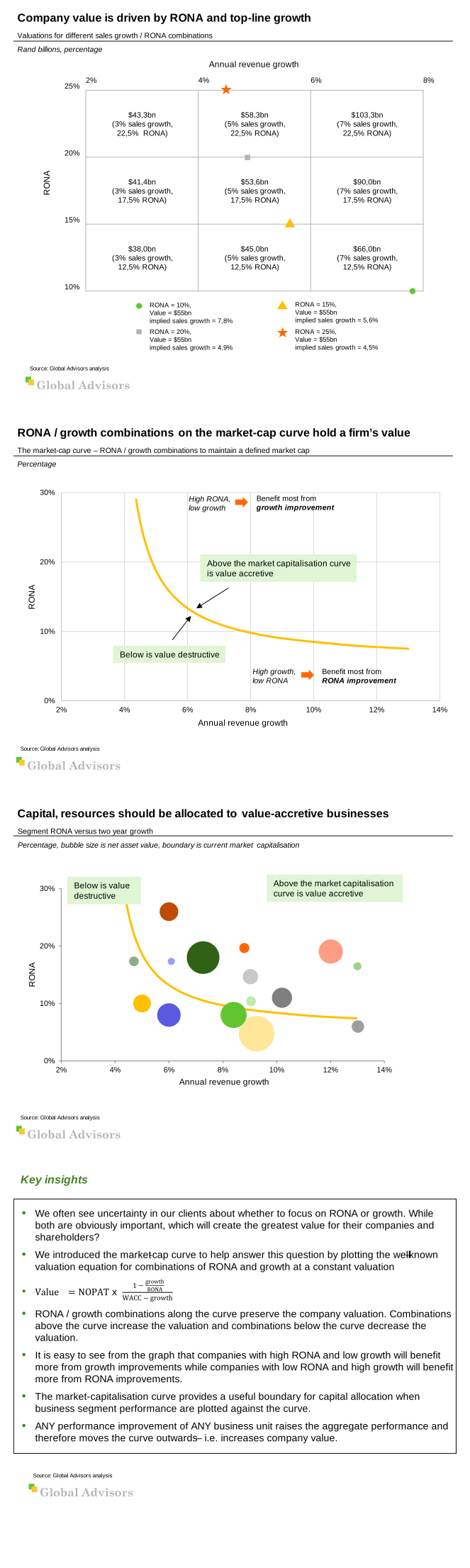
We often see uncertainty in our clients about whether to focus on RONA or growth. While both are obviously important, which will create the greatest value for their companies and shareholders?

We introduced the market-cap curve to help answer this question by plotting the well-known valuation equation for combinations of RONA and growth at a constant valuation.

RONA / growth combinations along the curve preserve the company valuation. Combinations above the curve increase the valuation and combinations below the curve decrease the valuation.

It is easy to see from the graph that companies with high RONA and low growth will benefit more from growth improvements while companies with low RONA and high growth will benefit more from RONA improvements.

The market capitalisation curve provides a useful boundary for capital allocation when business segment performance are plotted against the curve.

ANY performance improvement of ANY business unit raises the aggregate performance and therefore moves the curve outwards – i.e. increases company value.

read more
Strategy Tools: Growth, Profit or Returns?

Strategy Tools: Growth, Profit or Returns?

By Stuart Graham and Marc Wilson

Stuart is a manager and Marc is a partner at Global Advisors.
Both are based in Johannesburg, South Africa.

Growth, profit or returns? It’s all three, however we find that the relationship between these and shareholder value creation is poorly understood – if at all.

All three measures become critical to the way forward as companies navigate the Covid-19 crisis.

After ensuring business survival, navigating through the Covid-19 crisis requires returns on invested capital AND growth to deliver shareholder returns. S&P 500 companies averaged 13% RONA and 5% revenue growth (CAGR) through the financial crisis (2008-2012) .

Monolithic survival approaches may starve compensating growth opportunities – a portfolio approach is required.


Key insights

Returns are not enough – companies must also grow to create value.

Profits and cash flows cannot increase indefinitely through cost-reduction, efficiency, business mix, etc – top-line growth is critical.

Returns must be above costs of capital to be value accretive.

S&P 500 companies averaged 13% ROIC and 5% revenue growth (CAGR) through the financial crisis (2008-2012).

Margins and revenue growth, or even profit growth in themselves don’t answer that question of whether shareholder value was created or destroyed. There are many examples of where growth and high margins actually destroy value.

Company valuations reflect an aggregate of their business portfolio – rebalancing segments based on their growth and return profiles can lift company value.

Growth requires investment – at the very least in the working capital required to support revenue growth.

Measuring RONA or ROIC and Revenue growth shows whether business activity is value accretive or destructive.

You can use the Global Advisors Market Cap (valuation) framework to map your business – and agree action to deliver improved shareholder returns.

read more

Download brochure

Introduction brochure

What we do, case studies and profiles of some of our amazing team.

Download

Our latest podcasts on Spotify

Sign up for our newsletters - free

Global Advisors | Quantified Strategy Consulting